Saturday, January 07, 2006

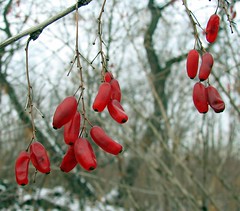
Common Barberry

Weekend Photoblogging


Common Barberry
Originally uploaded by urtica.

Here's another non-native species that is outshined by a relative. This is common barberry (Berberis vulgaris), a European species that is actually far less common around these parts than Japanese barberry (B. thunbergii) [though note that the "common" in its name is meant as "ordinary" rather than "plentiful"]. Its hanging yellow inflorescences, followed by these clusters of bright red fruit, make it much more attractive, IMHO, than Japanese barberry and its many cultivars...but don't take that as a recommendation to plant it, unless it's native to where you live.

Friday, January 06, 2006

Green Crab Blues

According to this report from The Capital Online, populations of invasive green crab (Carcinus maenas) found in the Chesapeake Bay are being kept in check by an unlikely source: native blue crabs (Callinectes sapidus). In taste tests, the blue crabs preferentially chose green crabs over foods they have eaten historically, like clams. The biologists studying the crabs recently published the results of their tests, done both in the lab and in the ocean, in an article in the journal Ecology.

Bonus points to The Capital for noting the scientific names of both crab species.

Thursday, January 05, 2006

An Aboriginal Thought

Interesting article from the North Queensland Register about the partnership developing between Australia's government and indigenous peoples that are concerned about invasive plants. A liaison officer for the Weeds CRC visits Aboriginal communities in remote parts of the Northern Territory to do public outreach, teaching groups to identify trouble-causing plants and to remove them. You can read more about the program in this weedwatch newsletter (.pdf).

Wednesday, January 04, 2006

Tangled Bank

A new edition of the Tangled Bank is here, complete with invasive species bookends. Check it out!

Tuesday, January 03, 2006

Duck à l'Estrange

In an effort to encourage native biodiversity, Cape Town South Africa has "replaced" non-native birds at two local dams with indigenous duck species. As reported by Reuters, yellow-billed ducks were bred and released in lieu of the mallard ducks (Anas platyrhynchos) and other alien birds species living there. No details are provided on what exactly "replaced" means but it can't be good. In case you're tending towards feeling sympathetic for the mallards, this press release paints them as aggressive, gang-raping thugs, messing with the normal breeding cycles of native South African ducks and producing hybrid offspring that have proved in some cases to be fertile.

Monday, January 02, 2006

The Single Guy

The Anchorage Daily News is reporting that after 25 years, starlings (Sturnus vulgaris) have firmly established themselves in the chilly climes of Anchorage, Alaska. There are now more than 150 of the birds living there - more than quadruple the number of birds known of just one year ago. A state wildlife biologist is concerned, but all he has so far is a single trap given to him by someone from the National Audubon Society. He's asking the public to contact the state Department of Fish and Game with information about the location of starling flocks, and is hoping to track them down to catch and euthanize them. The article points out that starlings are fair shooting game in Alaska. Somebody get this guy some more traps!

For more stories about invasive species in Alaska, check here and here.

Sunday, January 01, 2006

Weekend Blog Blogging

It's been a busy week for invasive species in the blogsphere:

  • Lantana camara makes a gorgeous but weedy Botany Photo of the Day over at the UBC Botanical Garden weblog.
  • It's urinalysis time over at bootstrap analysis - sure glossy buckthorn (Rhamnus cathartica) is a purgative, but who knew it made rabbits pee blue?
  • Someone at the CHCF Blog has got a flamethrower, and no weed is safe! (looks like fun)
  • Menotti over at Birding Italy Net has added two new Asian bird species to his lifelist. Benvenuto parrotbills!