A few years ago, San Mateo County inspectors recorded more than 2000 different pest organisms from inspections done at San Francisco International Airport and area nurseries. Last year that number was down to 275. But there is no celebration going on amongst the agricultural inspectors - the 80% drop in discovery of introduced species is attributed to a 50% reduction in funding for the inspection program. That's right - according to this report at Inside Bay Area, California has cut funding from $5.5 million per year to only $1 million per year for the entire state. There are currently efforts underway to raise the funding up to $17 million per year, which suggests that even with $5.5 million, the state wasn't getting good coverage. A Discover article from 1993 notes that the medfly (Ceratitis capitata) invasion cost California more than $170 million.
Friday, April 07, 2006

Thursday, April 06, 2006
Deep, Deep South
Scoop is reporting that the first ever workshop about "Non-Native Species in the Antarctic" is being held next week in Christchurch, New Zealand. The agenda, which you can view here (.pdf), will cover terrestrial and marine invaders, and how to deal with non-native species introductions within the context of the Antarctic Treaty System. This should be an interesting conference, dealing with a region we don't hear much about. The ISW has reported about Antarctic invaders only once before, back in January 2005.
Thanks to Sandy L. for posting about this on the ALIENS-L listserver.
Wednesday, April 05, 2006
The Olive Garden
According to this report from The Age, Australia's olive groves are producing a lot more than cooking oil and pizza toppings - they're producing weeds. Seems the olive trees (Olea europaea) have a tendency to go feral, and scientists are concerned that stricter regulations need to be put into place to prevent the trees from encroaching on native plant habitats. The scientists are recommending that every olive tree be covered with netting, to prevent birds from grabbing the fruits and dispersing the seeds. While there are an estimated 5 million olive trees currently "in production" in Australia, a significant part of the problem is with groves abandoned after an industry collapse way back in the 1800s.
Tuesday, April 04, 2006
It Came From eBay
Hey America: If you're looking for invasive plants to garden with, look no further than eBay...
- For only $10 plus shipping, you can be the proud owner of your very own Tree of Heaven (Ailanthus altissima)!
- Perhaps a Glossy Buckthorn is more to your liking? If so, the 'Fine Line' cultivar may be for you. It's "non-invasive" of course, and completely sterile! (Well, not completely)
- Oooo! Horned Poppy (Glaucium flavum)! And the seller says that they are *RARE* - do you think by "rare" she means "invasive"? The species is already a problem on the east coast of North America, maybe the goal is to get it naturalized throughout all of Canada?
- Saving the best for last: Purple Loosestrife (Lythrum salicaria). Can't ship to Ohio though...lucky Ohio. The buyer might want to check the other 49 U.S. states, since it is certainly illegal to plant purple loosestrife in New Hampshire, Minnesota, Massachusetts, Wisconsin...
Update: Here's another one: Phragmites australis. It's the best invasive "Giant Reed GRASS Bamboo PLANT" you'll ever grow from seed!
Update 4/6/2006: Toren has noted in the comments that the Purple Loosestrife auction linked to above has been removed...perhaps someone reported it. But never fear, if you act within the next 17 hours you can still buy some Purple Loosestrife seed fresh from Ohio.
Interested readers may also want to check out this 2003 ISW post for a list of other invasive plants that have been bought and sold on eBay.
Monday, April 03, 2006
Bee Line
According to this report from the Naples Daily News, it's time for Florida to face facts: The Africanized honeybee (Apis mellifera scutellata) is there to stay. Though also known as the "Killer Bee," it has not lived up to the initial hysteria that led to that name - after more than a decade in Florida, the insect still has not caused much trouble. However, experts are warning Floridians to be cautious around all bees, since the Africanized bees are aggressive, and the only reliable way to tell the difference between those and the calmer European honeybees (Apis mellifera) is by DNA testing. The article provides many details about the origin of the bees and their history, and even provides a bulleted list of things to if attacked. Interesting stuff.
Tip of the virtual hat to Taming of the Band-Aid for inspiring the very first ISW post about Africanized honeybees.
Sunday, April 02, 2006
Coming Soon: The ISW's 4th Blogiversary Bash!
April 13th is the 4-year Blogiversary of the Invasive Species Weblog. To celebrate, I'm having a contest:
The person who sends in the best invasive species-related post by midnight EDT on Thursday, April 13th will win his/her choice of one *FREE* item from the ISW Store. Entries may be sent directly to the ISW or posted on a different weblog (just email the link). Off-site entries are only eligible if they are posted between April 2nd and the deadline of the contest given above. While I may post or link to more than one entry, only the person who is judged by me to have submitted the best post will receive the prize.
Saturday, April 01, 2006
Weekend Photoblogging
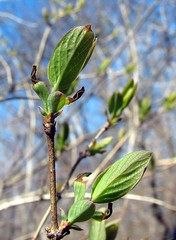
We are the Mighty Shrub Honeysuckles!
Originally uploaded by urtica.
These are one of my least favorite signs of spring :-) - the shrub honeysuckles. One of the first woodies to leaf out in March (maybe tied with multiflora rose). There's a bit of frost damage on the tips of the leaves but something tells me it's not going to make much of a difference to this plant.
The hairy undersides of the leaves (click on the photo to go to a lrager version) indicate this is either Morrow's honeysuckle (L. morrowii) or Bell's honeysuckle (L. x bella), the hybrid between Morrow's and Tatarian (L. tatarica). You'll have to wait until it flowers to know more than that - Morrow's honeysuckle has white flowers while the hybrid Bell's honeysuckle has flowers in various shades of pink.