Showing posts with label kudzu. Show all posts

Monday, December 15, 2008

Burn Notice

Is kudzu the new black? If Agro*Gas Industries has their way, it could be. A plant in Tennessee, started up this past summer, converts the wily invasive vine into ethanol, or..."Kudzunol." It takes about 10-15 pounds of kudzu to make a gallon of ethanol. Now, what happens when they start to run out of kudzu? Read more over at the Chemically Green blog, where they've got some serious, hard-core coverage of the issue.

Update: Here's a link to the NBC Nightly News report that spawned this post.

(Thanks to Mimi G. for sending in a tip about this story.)

Monday, December 31, 2007

KZ in AZ

Back in 2006, the ISW posted about the curious sighting of an infestation of kudzu vine (Pueraria montana var. lobata) out in Arizona. Ed Northam recently sent out an update to his Arizona Weed Notes listserver, and has kindly given me permission to reprint the note here, along with some excellent before and after photos:

In September 2006, Arizona’s first reported population of Kudzu [Pueraria montana (Lour.) Merr.] was discovered in Huachuca City, Cochise County.

During early October 2006, plant samples collected from that unusual, sprawling, densely leaved, woody vine, plus photos by Jeffrey Myers, AZ Dept. of Agriculture, was enough evidence for Dr. Ed Northam, Invasive Plants Program Manager, University of Arizona Cooperative Extension Office, Maricopa County to conclude that Arizona had a population of Kudzu.

Dr. Kelly Steele (plant taxonomist, AZ State University Polytechnic) also confirmed the initial vegetative diagnosis. DNA sequence analysis of leaf samples from Huachuca City by Dr. Martin F. Wojciechowski, Associate Professor, ASU Tempe, School of Life Sciences, matched published Kudzu DNA sequences.

Kudzu attracts attention from Arizona plant scientists and land managers because this foreign vine has demonstrated its ability to dominate and smother both land and vegetation. Mature pine trees, roadsides, telephone poles landscape plantings in southeastern states have been buried under Kudzu’s invasive growth.

Because of Kudzu’s reputation as a biotic invader, AZ Dept. of Agriculture personnel initiated an eradication process when identification was completed. This control measure is based on a new herbicide from Dow AgroSciences called Milestone VM.

Vince Aguiar, Dow’s range and pasture vegetation specialist for Arizona provided weed management expertise for eradication treatments that began in November 2006.

Milestone was applied to the Huachuca City Kudzu at a rate of 7 oz. per acre. This application was repeated in March and June 2007. Visual estimates in August 2007 indicated >97 percent of Kudzu biomass died as a result of those three treatments (see photos provided by Arizona Dept. of Agriculture).

Even though the Kudzu infestation appears to be controlled, treatments are planned for 2008 to complete eradication and will continue until new shoots cease to emerge; then occasional monitoring is needed to insure none of the underground root reserves survive and clone new Kudzu plants.

Approximately 1/4 of Huachuca City Kudzu infestation -- Oct. 2006 Summer 2007 view showing excellent reduction of Kudzu infestation after treatment with 7 oz/acre of Milestone VM in Nov. 2006, March 2007 and June 2007.

Source: Northam, Ed. Arizona Kudzu: One Year Update. ARIZONA WEED NOTES. Dec. 11, 2007. Phoenix, AZ.

Sounds like they will have nipped this invasion in the bud after another couple of years of treatments and monitoring. Go AZ!

Sunday, September 09, 2007

Weekend Photoblogging

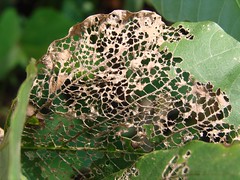
Something ate the kudzu!

(Thanks to Martin for sharing this photo under a Creative Commons license.)

Sunday, May 06, 2007

Weekend Photoblogging


Kudzu on the move.
Originally uploaded by k.lifka.

Kudzu - not your average sessile plant.

You have to give props to a terrestrial vascular plant that can live its entire life as a hitchhiker :-).

Sunday, April 15, 2007

Weekend Photoblogging


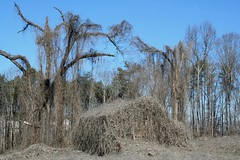
The Brown Winter
Originally uploaded by Jacob Krejci.

I almost didn't post this photo because it's from January, but darnit it's about to snow here in Massachusetts, so a photo from South Carolina called "The Brown Winter" seems appropriate. Unfortunately in this case, the culprit is not snow, but kudzu, or as the photographer puts it, "a brown blanket of death."

Thursday, October 12, 2006

How Dry I'm Not

Just got an interesting email alert:

AZ-WEED NOTES: 9 Oct. 2006; Phoenix, AZ

ARIZONA KUDZU DISCOVERY

According to USDA’s Plants database the closest Kudzu populations to Arizona are in eastern Texas.

However, Huachuca City residents say that a strange, sprawling, densely-leaved vine that is smothering a desert broom shrub by their Lions Club building has been around at least 5 years.

During the last week of September, David Madison (Arizona Dept. of Agriculture) collected a sample of the Cochise county plant that eventually ended up at the Maricopa County U-of-AZ Cooperative Extension office on the desk of Dr. Ed Northam, Invasive Plants Program Manager.

Kudzu produces flowers in late summer in other states, so that diagnostic trait was not present on samples collected during the following several days.

In other words, stems, leaves, roots and on site photographs were needed to compile enough vegetative characteristics to determine that Arizona’s first Kudzu (Pueraria) population is thriving in a mountainous semidesert region at an elevation of 4300 feet.

A second opinion was requested from Dr. Kelly Steele (ASU plant taxonomist), and she agreed with the initial diagnosis.

Since Kudzu has demonstrated that its roots can survive winter conditions as far north as Massachusetts, Illinois, Oregon and Washington, it is not surprising that Arizona has areas above 4000 feet elevation that will support Kudzu growth, especially when summer monsoon conditions are wetter than usual.

If you are in Arizona this fall and notice a large woody vine with 3-leaflet compound leaves (leaf length ranges from 4 to 10 inches including a hairy petiole), collect a sample and send it to the Maricopa Cooperative Extension Office.

Kudzu plants that have been growing all summer will have above ground runners that are several feet long; also check to see if an extensive lateral root system is present.

There are photos here; Picture 2 has got a good shot of the infestation.

(I hope they pulled the darn thing out!)

Monday, May 16, 2005

Kudzu Cocktail

As heard on WBZ 1030 this afternoon, Reuters is reporting that doctors have found that an extract made from the invasive kudzu vine (Pueraria montana var. lobata) appears to curb binge drinking. Authors of the medical study suspect that something in the kudzu makes people satisfied with a smaller amount of alcohol than they typically consume. Participants in the study were given either kudzu extract or a placebo, and were then brought to an apartment with an entertainment center and bar. Wow - where can I volunteer to be a guinea pig? :-)

Monday, May 09, 2005

Kudzu? Can Do!

Interesting article from National Geographic about a woman in Appalachia who makes products out of kudzu (Pueraria montana). Nancy Basket makes paper, candies, and, of course, baskets from the invasive vine. Be sure to click on the article link so you can see the photo of her artist's studio, which is insulated with bales of kudzu.

Thanks to Val C. for sending in a link to the article.

Wednesday, January 19, 2005

Kudzu was Here

Jack Anthony has put together an amazing online photo journal of kudzu (Pueraria montana) doing its invasive thing. See it covering signs, buses, and even entire houses.

Thanks to Val C. for sending in a link to this cool site.

Monday, September 30, 2002

Invading a video screen near you

Mark your calendar for October 15th, from 1pm-4pm ET; you don't want to miss the Federal Highway Administration's teleconference, "Invasive Species in Transportation Rights of Way:"You Wouldn't Plant Kudzu, Would You?" ." The conference will feature panel discussions about the role of interstate highways in the spread of invasive plants, and programs that have been implemented to hinder that spread. If you can't make it to one of the program's broadcast sites, you can watch it live on the web.

Thanks to a member of the Yahoo! group ma-eppc for posting information about the conference.

Tuesday, September 24, 2002

Mmmm....Kudzuuuu

If you're near Blythewood, South Carolina this weekend, be sure to stop by the 27th annual Blythewood Kudzu Festival. They've got more uses for Kudzu (Pueraria lobata) than you could ever imagine, from clothing to baskets to yummy jams and sandwiches. It is great to see the folks in Blythewood making lemonade from a hefty crop of lemons. But before you decide to get some Kudzu to start your own local festival, remember that this invasive vine is on the U.S. Federal Noxious Weed list, and is also banned in many states.

Thursday, August 22, 2002

Army Battles Kudzu

Kudzu (Pueraria montana var. lobata) is still a force to be reckoned with, and is in fact making its way northward through the U.S. According to this article from the Washington Times, the U.S. Army is dealing with a major kudzu infestation at Fort Pickett, Virginia, where the aggressive vine is taking over training grounds, rendering foot paths difficult to traverse and roads invisible. This Chinese native, introduced to America in the late 19th century as an ornamental and in the early 20th century for erosion control, is also a haven for the deadly copperhead snake (Agkistrodon contortrix), making infested areas even more dangerous for soldiers.