Thursday, May 26, 2005

Time Off for Bad Behavior

No takers for the Guest Blogger position (my ego is crushed), so it looks like the ISW will be taking some time off - back on June 1st. Until then, please study this lovely photo of the invasive Bell's honeysuckle (Lonicera x bella), from a population in Quincy, MA. Very dark pink flowers, as found in its parent, Lonicera tatarica, but the leaves are quite hairy underneath, as found in its other parent, Lonicera morrowii.
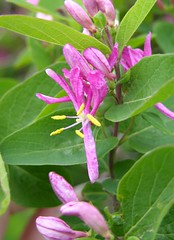

Bell's Honeysuckle
Malaysian Maladies

As reported by the New Straits Times, Malaysia is facing a problem following repeated releases of non-native animals. Both the North American bullfrog (Rana catesbeiana) and the Taiwanese edible frog (Hoplobatrachus chinensis) are raised in Malaysia for food. Unfortunately some well-meaning people have been "rescuing" the frogs from their likely dinner plate destination, by releasing them into local natural areas. Ironically, the last big batch of Taiwanese edible frogs to be found in a botanical garden were recaptured and sent off to a Chinese restaurant.

Bonus points to the New Straits Times for using the frogs' scientific names. But -1 for misspelling Hoplobatrachus. And +1 to Google for recognizing the misspelling :-).

Wednesday, May 25, 2005

So Sue Me

The Food and Agriculture Organization (FAO) is being sued by a group of Kenyans in an effort to get the FAO to take responsibility for spreading the invasive Prosopis juliflora, according to this report from AllAfrica.com. Affectionately called "Devil trees," but known here in its native America as Mesquite, Prosopis was intentionally introduced to Kenya by the FAO back in the 1970s and 1980s to combat soil erosion and provide a firewood source. Now the growth of this species is out of control, and local people want the FAO to remove plants and replace them with native flora.

Thanks to a member of the Yahoo! group ma-eppc for posting about this story. Bonus points to AllAfrica.com for using the plant's scientific name.

Tuesday, May 24, 2005

Eggstraterrestrial Field Work

Intersting piece in The Capital about the work involved in trying to control the invasive mute swan (Cygnus olor) in Maryland. Field workers charged with doing the job must hunt down swan nests, typically navigating through mucky wetlands to do so. Any eggs found are sprayed with an oil that cuts off all air flow through the shells, which prevents the eggs from hatching. Maryland's Department of Natural Resources hopes to target 300 swan nests this year, potentially stopping over a thousand mute swans from joining current populations.

Monday, May 23, 2005

Whirling Gig

ESPN Outdoors is reporting that almost 1 million rainbow trout (Oncorhynchus mykiss) in a hatchery in Utah will have to be destroyed after several of the fish were found to be infected with whirling disease (Myxobolus cerebralis). Caused by a parasite, whirling disease is thought to have been introduced through European salmonid fish during the 1950s. Some native trout species, salmon, and possibly even whitefish are susceptible to the parasite, making it even more perilous to release infected hatchery fish into local water bodies. Of course, the rainbow trout is also considered an invasive species in several parts of the U.S.

Tip of the virtual hat to the Stop Aquatic Hitchhikers website for posting about the article.

Saturday, May 21, 2005

Bee Bomb

As reported in the Springfield News-Leader (among many others), honeybee populations in the U.S. have been decimated by infestations of the Varroa mite (Varroa jacobsoni). Nationwide, the number of hives are at about 50% of what they were a year ago, after a cold winter where the bees slowed down but the mites did not. Unfortunately the mites have evolved a resistance to the two main insecticides being used against them. Expect not only less honey, but fewer and more expensive fruits and vegetables in the supermarkets this season.

Friday, May 20, 2005

Thirst Quenchers

There is an interesting side effect of the current drought in Australia, according to this report from ABC News Australia. Seems gardeners, unhappy with the lack of rain, are looking to the internet in their quest to grow plants that stay lush and green. Unfortunately descriptive phrases like "drought resistant" and "drought tolerant" are often associated with plants not native to Australia, including species considered invasive in that country. Interested readers will also want to check out this related article that was featured in the environment & nature section of ABC News Australia last March.