DNR in Maryland says that mute swans have to go, egg addling and killing of adult swans to continue.
Showing posts with label mute swan. Show all posts
Showing posts with label mute swan. Show all posts
Tuesday, June 09, 2009

Saturday, February 09, 2008
Weekend Photoblogging
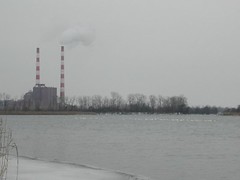
Mute swans, a whole lot of them. They're there, though you might have to click through to the photo page for confirmation.
Stylurus notes that "On December 28, 2004, we counted 590 individuals at this location."
(Thanks to Stylurus for allowing me to post this photo.)
Sunday, August 12, 2007
Weekend Blog Blogging
The past week in invasive species blogging:
- Lake Loop has an informative post about not one, but two different invasive threats to the native West Virginia white butterfly.
- Stephen Bodio's Querencia blogs about the biological control of Tamarisk, and spawns a number of interesting comments.
- Elijah Weber posts the second of a two-parter about ethics and the mute swan conundrum over at the Mindful network. Part one was back in June.
Saturday, March 24, 2007
Weekend Photoblogging
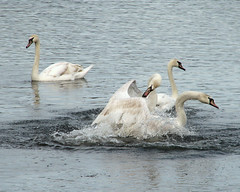
Swans of the day
Originally uploaded by urtica.
I've only ever seen mute swans (Cygnus olor) in pairs or alone, but at Farm Pond in Framingham this past Friday, there were at least 20 of them, and they were getting a little frisky :-).
On a related note, John Peter over at Invasive Notes recently blogged about a group of people very, very dedicated to their neighborhood mute swan, even after its death.
Sunday, January 28, 2007
Weekend Photoblogging
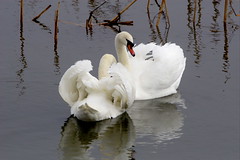
Mute Swans (Wild)
Originally uploaded by Rick Leche.
I've got mute swans on the brain...and there are lots of them in the Creative Commons pool over at Flickr, including the lovely photo above, taken by Rick Leche.
Friday, January 26, 2007
Adopt-A-Swan
The Wisconsin Journal-Sentinel is reporting that the state's Natural Resources Board has decided to employ an experimental adoption program in their efforts to control invasive mute swans (Cygnus olor). Residents that are interested in sponsoring a swan must be willing to pay to neuter and band the bird. The move comes in response to the staunch opposition to current mute swan control programs, which include culling and addling eggs to prevent them from hatching.
I am not aware of the details of the program, but I wonder if it will be possible for enough of the swans to get "adopted" such that reproduction virtually ceases. As soon as I can locate more information (including the cost of adoption), I'll post it here. In the meantime, if there's a Wisconsin mute swan you've had your eye on, be sure to register with the state by June 1st 2007.
Update: bootstrap analysis has weighed in on the mute swan adoption plan, definitely worth a read.
Wednesday, June 28, 2006
Off the Hunt
Today, Indiana's Department of Natural Resources released this press release that describes a revision of their mute swan policy. The new rules make it much harder to acquire a permit to "control" (shoot) the swans - applicants now need to provide documentation that the bird is indeed a mute swan (Cygnus olor), and permits will only be issued for "nuisance" swans. Wha - are they afraid of running out or something? :-)
Tuesday, May 24, 2005
Eggstraterrestrial Field Work
Intersting piece in The Capital about the work involved in trying to control the invasive mute swan (Cygnus olor) in Maryland. Field workers charged with doing the job must hunt down swan nests, typically navigating through mucky wetlands to do so. Any eggs found are sprayed with an oil that cuts off all air flow through the shells, which prevents the eggs from hatching. Maryland's Department of Natural Resources hopes to target 300 swan nests this year, potentially stopping over a thousand mute swans from joining current populations.
Friday, March 18, 2005
Wingin' It
The U.S. Fisheries and Wildlife Service is out with their final list of bird species that are not protected under the Migratory Bird Treaty Act. The MBTA became an issue for invasive species management because of lawsuits invoking it to protect birds like the mute swan (Cygnus olor). Get a .pdf of the document here (list is at the end), and more information from the F&WS here.
Thursday, December 09, 2004
The Swan Hunters
Presumably while no one was looking, Maryland environmental officials got U.S. Representative Wayne Gilchrest to remove a major barrier to mute swan (Cygnus olor) control in that state. As reported by WJZ News, Gilchrest "slipped" language into a bill that keeps the swans from being protected under the Migratory Bird Treaty Act. Then the "Migratory Bird Treaty Reform Act of 2004" managed to make its way into the omnibus spending bill that recently passed the House. WJZ also links to a video version of the story.
Monday, August 09, 2004
Swan Dive?
ABC News is reporting that there is a movement underway in Congress to amend the Migratory Bird Treaty Act to exclude introduced species. If passed, H.R. 4114 would leave officials in states plagued by the aggressive mute swan (Cygnus olor) free to commence culling programs. They must be gearing up for a fight in Maryland!
Friday, September 19, 2003
Swan Song Redux
Looks like Maryland's burgeoning mute swan population (Cygnus olor) has gotten a stay of execution, at least for the next couple of years. According to this article from SunSPot.net, the dispute between state wildlife officials and animal rights' organizations went all the way to federal court, where it was decided that all permits to shoot the swans would be revoked. The permits cannot be reissued until the federal government completes an environmental impact study to determine the effects the swans have on habitat and native species. The state is currently looking into alternative methods to reduce the number of swans, most likely by treating eggs with oil to prevent them from hatching.
Thursday, September 11, 2003
The Place To Be
Let's say you're an up-and-coming invasive species, where would the hip place to hang out be? Probably Maryland, temporary home of the infamous northern snakehead (Channa argus) and likely permanent home of the mute swan (Cygnus olor). That's exactly where the emerald ash borer beetle (Agrilus planipennis) has headed as well, according to this article from the Washington Post. The insects, first discovered in the U.S. last year, had previously been found only in Ohio and Michigan. An as of yet unidentified nursery in Maryland received at least one shipment of contaminated ash trees, which will now be destroyed, from another nursery in the state of Michigan (which has banned the sale or transport of ash trees in several counties). Officials are also looking into whether the nursery in question accidentally shipped the contaminated trees to a site in Virginia as well.
Tuesday, July 08, 2003
Think Locally, Act Globally
It turns out it's not just state officials that are concerned about burgeoning mute swan (Cygnus olor) populations in the U.S. (see previous blog entry). The U.S. Fish and Wildlife Service has a plan, currently open to public comment, that seeks to eradicate as much as 85% of the swans in the eastern U.S., in part by allowing states to issue permits to shoot the graceful invasives. Of course there are swan fans and animal rights activists very concerned about this, and you can read some of their points of view, as well as those of state wildlife officials, in this article about swans in my hometown, published in the Metrowest Daily News. If you would like to read the USFWS' draft environmental assessment for mute swan management, go here and click on the link (to a .pdf file). The deadline for comments is July 14th. Also, claims from people interviewed for the article that there was no evidence of the swans being invasive led me to search for and find evidence here and here.
Thursday, July 03, 2003
Dirty Bird!
Sure, they're graceful, they're fun to feed, and their babies are the cutest things...but they're also nasty poop machines that pollute the water and devour aquatic vegetation. So goes the battle between those who love mute swans (Cygnus olor) and Canada geese (Branta canadensis) and those who wish to preserve native plants and animals, even if it means euthanizing charismatic megafauna. The drama continues in Maryland, where wildlife officials have just gotten permission to resume their reduction of mute swan populations (see previous blog entry), now thought to have expanded to over 14,000 birds. According to this article from the Maryland Sun, animal rights' activists in that state continue to fight the extermination program. In New Jersey, as reported in the New York Times, officials are meeting opposition to their efforts to rid the state of more than 2500 Canada geese, whose presence has significantly reduced park usage by humans. The Hartford Courant is reporting that Connecticut is also getting into the geese-hating act, having just approved a law to allow any homeowners to kill Canada geese if they can prove they have exhausted all efforts to make them go away.
Thanks to members of the ALIENS-L listserver for posting links to these stories.
Sunday, May 25, 2003
Swans: regal birds of beauty, or nasty invasive species?
The debate over mute swans (Cygnus olor) continues, having now spread to Massachusetts. As reported in today's Boston Globe, some residents of Plum Island were alarmed to discover that for the past twelve years, workers in the wildlife sanctuary regularly "thin the ranks" of swans to keep them from scaring off native birds and consuming massive quantities of aquatic plants. At issue is exactly which creatures deserve the "Refuge" in Parker River National Wildlife Refuge. If you don't feel like reading the whole article, at least have a look at the resident quotes at the bottom of the page. You can also read about the mute swan hysteria in Maryland by clicking over to this previous blog entry.
Friday, May 09, 2003
Swan Song
According to this report from the Bay Journal, natural resource officials in Maryland have begun the process of shooting 1500 mute swans (Cygnus olor), in an effort to protect grassbeds and native species in the Chesapeake Bay. When they're done, swan populations in that state will be reduced by about 50%. The number of mute swans in Maryland has continued to rise, even though there has been an egg addling program in that state for years. In response to the killings, the international animal rights group "Friends of Animals" is offering up to $1000 to anyone who can catch the shootings on video tape, as reported in the Washington Post. The group hopes to stop the population reduction program by broadcasting the tape to the world.
(Note 5/25/03: Animal rights supporters have now filed a lawsuit in federal court to protest the swan killings, read more in this story from the Environment News Service. - Thanks to a member of the ALIENS-L listserver for posting the link)
Sunday, July 28, 2002
Swan Song?
An annoying Mute swan (Cygnus olor) frequenting the Eel River in Plymouth, MA is being given one last chance to learn to avoid humans before town officials vote to ship it off to a wildlife sanctuary. According to this story in the Boston Globe, the swan is a danger to people using the river for activities like boating and fishing. Plymouth will have to get approval from the state to move the swan; it appears that euthanization is the preferred method of dealing with aggressive wild animals.
Subscribe to:
Posts (Atom)