Forget goats or sheep...or beetles! A Colorado rancher wants to enlist *camels* in the battle against the invasive shrub known as tamarisk (saltcedar, Tamarix spp.).
Showing posts with label tamarisk. Show all posts
Showing posts with label tamarisk. Show all posts
Sunday, February 14, 2010

Monday, March 16, 2009
Out Of Biocontrol
An excellent piece in the Salt Lake City Weekly about the current furor over the impact that a beetle released to attack invasive tamarisk shrubs (Tamarix spp., saltcedar) is having on an endangered bird. Seems the releases of leaf beetle Diorhabda elongata as a biocontrol were a lot more successful than people had anticipated, often leading to massive tamarisk defoliations that left the nests of the Southwestern willow flycatcher completely exposed. Add to that some miscommunication between state and federal agencies and the tendency of tamarisk to take over wide swarths of riparian land, and you've got...a complicated situation.
Tip of the virtual hat to the Aridzona Weed News Forum for posting a link to this article.
Sunday, March 23, 2008
Athel Murmuring
The Las Vegas Sun has an article about an up-and-coming tamarisk species making its way around Lake Mead. The athel tree (Tamarix aphylla) is evergreen, grows quite a bit larger than other saltcedars, and until recently was thought to be sterile and therefore not a threat. Following the removal of over 20,000 trees by the National Park Service, that opinion has likely changed (apparently Australia doesn't like it much either).
Sunday, August 12, 2007
Weekend Blog Blogging
The past week in invasive species blogging:
- Lake Loop has an informative post about not one, but two different invasive threats to the native West Virginia white butterfly.
- Stephen Bodio's Querencia blogs about the biological control of Tamarisk, and spawns a number of interesting comments.
- Elijah Weber posts the second of a two-parter about ethics and the mute swan conundrum over at the Mindful network. Part one was back in June.
Sunday, October 22, 2006
Weekend Photoblogging
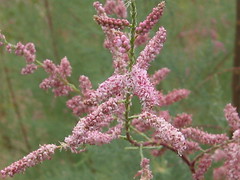
pink tamarisk
Originally uploaded by miheco.
Beautiful, invasive tamarisk in flower in California.
Bonus points to miheco for sharing this photo under a Creative Commons license!
Friday, October 14, 2005
Tamarisk Assessment
You probably missed it, but today marks the end of the 2005 Tamarisk Symposium. Among the highlights, according to this article from The Daily Sentinel, were claims by scientists that eradicating tamarisk (Tamarix spp.) will not be the cure-all for the water woes of the western U.S.
One of the main reasons tamarisk gets so much attention is the claim that the shrub's high water demand will hurt those who depend on the Colorado River as their water source. Preliminary results of a study to be released later this year indicate that replacing tamarisk with native trees led to no measurable water savings. However, areas with native grasses and shrubs did use 30-60% less water. As usual, the situation is much more complicated than can be explained by a single invasive species.
Monday, August 15, 2005
Tamarisky Business
Tony over at milkriverblog posted this piece about the beetles being released in Texas to control the invasive saltcedar (tamarisk, Tamarix spp.). He became familiar with saltcedars when studying a bird that uses the shrubs as nesting material. Included in his post is a good article about the biocontrol project from the San Antonio Express-News. In their effort to establish breeding populations of the saltcedar leaf beetles (Diorhabda elongata), biologists are sampling from all over the geographic range of the species, from Crete to Western China. Hopefully when these gene pools start to mix we won't find ourselves with something that develops a voracious appetite for something unexpected. As the article notes, Mexico is already worried, since they've been planting athel (Tamarix aphylla) in the northern part of the country (um...guys...time to try out a new windbreak).
Wednesday, October 15, 2003
Biocontrol Bonanza
Yet another weapon has been added to the U.S. biological control arsenal: Yahoo! News is reporting that New Mexico has joined other western states in releasing Tamarisk leaf beetles (Diorhabda elongata) to manage burgeoning populations of salt cedar (Tamarix spp.). Salt cedar is an invasive tree that causes problems in the already drought-prone western U.S. with its thirsty, water-seeking root system. Right now, this biocontrol is still in the testing phase - scientists are hoping the beetles survive the cool New Mexico winters and can multiply in the spring. There is also some concern that if the beetles have a negative effect on salt cedar, this will in turn have a negative impact on the endangered Southwestern willow flycatcher (Empidonax trailii extimus), a bird which has taken to nesting in the salt cedar that has replaced the native vegetation of its habitat.
Thanks to Jeremy at BioHabit.org for emailing the link to this report.
Update:There was a conference in Colorado on October 22 where the USDA announced a widespread project to release the leaf beetles in 13 different states next spring. You can read a brief story about it at news4colorado.com (Thanks Alex).
Tuesday, July 29, 2003
Colorado couldn't care less...about Tamarisk
This Saturday is the fifth annual Colorado Cares day. According to this article from the Rocky Mountain News, the goal for this year is to rid the state of the invasive water-hungry tree known as tamarisk (Tamarix spp.). Even the governor of Colorado has pledged to join in on the weed pulling, and if you're in Colorado the article provides contact information, so you too can get involved.
Sunday, February 16, 2003
Quenching their thirst
As reported by The Denver Post, a state representative in Colorado has introduced a bill that will grant $1 million to Mesa State College to support their efforts to eradicate invasive tamarisk trees (Tamarix spp.) from the state. The bill is part of a drought-relief program, with tamarisk targeted due to its extremely high water demand and tendency to inhabit riparian ecosystems. A grassroots organization, the Tamarisk Coalition, will assist with the project, which will involve local, state and federal agencies as well.
Thursday, June 13, 2002
Invasive Plants non grata in San Diego
A member of the Yahoo! newsgroup ma-eppc posted a reference to this article about a proposal by the San Diego City Council to "ban the sale, distribution and cultivation" of four well-known invasive plant species: Pampas grass (Cortaderia jubata), Tamarisk (Tamarix sp.), Giant reed (Arundo donax) and German ivy (Delairea odorata or Senecio mikanioides) (Would have been be nice to have the scientific names in the article!). The proposal is similar to the restrictions put into place by Palm Beach County, Florida. The minutes of the Council meeting may eventually posted here.
Subscribe to:
Posts (Atom)