Showing posts with label trees. Show all posts
Showing posts with label trees. Show all posts
Sunday, March 28, 2010
Hawaiian Punch
Hawaii has found success with a biological control in the effort to save endangered wiliwili trees from invasive gall wasp.

Friday, September 11, 2009
Opining
Invasive Australian pines (Casuarina spp.) hybridizing in Florida, but apparently not in native Australia. Makes biocontrol development tricky. Via ARS News.
Sunday, March 23, 2008
Athel Murmuring
The Las Vegas Sun has an article about an up-and-coming tamarisk species making its way around Lake Mead. The athel tree (Tamarix aphylla) is evergreen, grows quite a bit larger than other saltcedars, and until recently was thought to be sterile and therefore not a threat. Following the removal of over 20,000 trees by the National Park Service, that opinion has likely changed (apparently Australia doesn't like it much either).
Sunday, March 09, 2008
Weekend Photoblogging
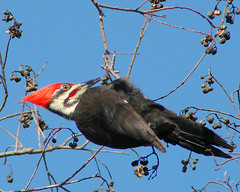
Last week on Flickr I happened upon a nice shot of an American robin dining on the fruits of the invasive Chinese tallow tree (Sapium sebiferum, also known as "popcorn tree"). A quick note to the photographer led me to a whole set of his shots of this tree, including several amazing ones of birds, such as the Pileated woodpecker shown here. Be sure to scroll down this page to view the photos and read more about Chinese tallow.
Thanks to Dixie Native for giving me permission to display this photo and for pointing me to his other shots.
Friday, February 08, 2008
Native Or Not: You Make The Call
(Another installment in the very infrequent series)
The North-West Evening Mail is reporting that efforts are currently underway to get beech trees (Fagus sylvatica) declared as native in Northwest England, in order to protect them from being cut down. The evidence being presented in support of the change in classification is ancient pollen indicating beech was present back in prehistoric times in what is now known as the county of Cumbria. Things are complicated by the fact that many of the beech stands in the area are known to have been planted, and by the fact that Southern England, where the beech is considered native, is experiencing a decline in the species thought to be tied to climate change. As the campaign presses on, there remains some controversy regarding the history of the species in England, as well as whether beech should be considered an invasive species, whether it is native or not. You can read more about the campaign to protect the beech here.
Thursday, January 24, 2008
Heaven Sent Away
The Herald-Leader is reporting that the first major steps have been taken to remove the tree-of-heaven (Ailanthus altissima) that has invaded the Henry Clay Estate in Kentucky. The trees have been targeted because they are encroaching upon one of the last remaining populations of running buffalo clover (Trifolium stoloniferum), a federally listed endangered plant that is so rare, it was once considered to be extinct. Full-grown trees are being cut and carefully removed, so as not to disturb the clover, and volunteers have been working to remove tree-of-heaven seedlings as well as the invasive Japanese stiltgrass (Microstegium vimineum).
Friday, January 18, 2008
Mangrove Stands...Again
San Diego has itself a case of invasive mangroves. For a type of tree best known as a component of rare and treasured wetland ecosystems, this may surprise some. Yet several decades ago, someone decided to plant gray mangroves (Avicennia marina) in Mission Bay, California, and according to this story from the San Diego Union-Tribune, they won't go away. Apparently the species was thought to have been eradicated from the bay over ten years ago, but is now back with a vengeance. A team of volunteers led by the Audubon Society is currently working at removing the trees, in the hopes of creating more suitable nesting habitat for endangered birds that frequent the wetland.
Sunday, January 13, 2008
Weekend Blog Blogging
The past few weeks in invasive species-related posts, from around the blogosphere:
- Paul at The force that through... posts about a Brazilian pepper bush (Schinus terebinthifolius) he found at Disney World.
- A Snail's Eye View has an interesting post about the invasive white snail (Theba pisana) threatening agricultural crops in Australia.
- Speaking of snails (who knew there were so many snail-related blogs?), A Snail's Tale posts about some interspecific competition between cats and rats on an island off the coast of New Zealand.
- Butterflies of Singapore has some excellent photos of a lovely painted lady (Vanessa cardui). While the species has ac osmopolitan distribution (thanks chelydra), BoS questions whether the discovered specimens were bred and released, or perhaps escapees.
- Politician Glyn Davies has a View from Rural Wales, and that view is filled with invasive American grey squirrels.
Thursday, January 10, 2008
Tsunami Balm?
In a similar vein to yesterday's post, today the ISW presents another dilemma that pits the problems of invasive species against the needs and desires of humans.
The Indian environmental journal Down to Earth has an interesting article asking whether it is smart to be planting trees and shrubs to act as barriers against tsunamis and other storm action. Many of these "bioshields" are being created from monoculture plantations of Australian pine (Casuarina equisetifolia), a known invasive species. Scientists want to take a step back and approach the protection of the shoreline by examining the coastline more closely, and as the article notes, native species and natural barriers such as sand dunes can also effective at dampening the effect of wave action. However, the government insists that this approach is not practical with so much of the coastline already developed, and will proceed planting trees "wherever we find land."
Wednesday, January 09, 2008
Al. B. Not-So-Sure
A company that has developed a biomass facility to turns plants into electricity is currently under fire on the island of Kaua'i, Hawaii. According to this report at The Garden Island, Green Energy Hawai‘i has chosen Albizia (Albizia chinensis) as their main source of fuel, which is not sitting well with officials since the tree is not native to Hawaii. As with many species eyed as sources of energy or biofuel, Albizia is prized for its ability to grow fast and to tolerate low-nutrient conditions. Unfortunately, these are characteristics that could make this species a successful invader, and indeed Albizia has already been cited as such on the island of Samoa.
Green Energy Hawai‘i has been planting acres of both Albizia and eucalyptus (also not native) in preparation for starting up their plant, but the company is now being asked to phase out Albizia over the next decade and to find an alternative species to use instead. With a law in place requiring 20% of power generation to come from renewable energy sources by 2020, I suspect Hawaii is going to continue to encounter similar dilemmas in the near future.
Monday, December 31, 2007
Weekend Photoblogging
Wednesday, December 26, 2007
Tallow Grave
While the ISW has previously reported about Chinese tallow tree (Sapium sebiferum) here in the US, it was interesting to read that this species has also become a nuisance in India. The Telegraph is reporting that the tree, which was intentionally introduced to India as a source of vegetable oil, is spreading on its own into natural environments. Chinese tallow tree has allelopathic tendencies, releasing toxins into the soil that are likely to kill the surrounding plants wherever it sprouts up. Scientists in India are smart to note that this species, while not yet officially recognized as invasive in their country, has already become a problem in the southern USA, and thus has the potential to do the same in India.
Interested readers may also want to check out this similar story of a crop plant gone wild in Ghana.
Friday, December 21, 2007
Pulp Friction
The Ghanaian Chronicle is reporting that Ghana's landscape under threat from non-native tree species. The paper mulberry (Broussonetia papyrifera, called "pulp mulberry" in the article), native to Asia, was intentionally introduced to Ghana back in the late 1960s for its use in fiber production. Since then, it has become quite invasive in that country, and is difficult to control in areas where it becomes established. While it is a particular problem in some farming communities, it is also invading more natural areas such as forest reserves. With no effective controls in place, scientists are currently working on a management plan so that affected land owners will be better able to deal with this species.
(Bonus points to the Ghanaian Chronicle for using the plant's scientific name.)
Tuesday, November 13, 2007
Going Bo Bo
The Molokai Times reports that last week's meeting of the Maui Invasive Species Committee revealed several interesting new invaders on the Hawaiian islands of Maui and Molokai. Perhaps most intriguing is one botanist's observation that the bo tree (Ficus religiosa, also known as the sacred fig), an Asian import often planted as a religious symbol, is on the move. Once thought to be able to spread only by cuttings, the bo tree is apparently now able to reproduce by seed, following the recent arrival of a wasp that can act as a pollinator. Surveys of Molokai for wild bo trees are in progress, along with plans to prevent the trees from producing seeds. The committee is also asking anyone on Maui or Molokai that knows the location of a bo tree to contact them.
Bonus points to the Molokai Times for using the bo tree's scientific name.
Thursday, October 18, 2007
The Yugo Of Invasive Plants
There's an interesting article from the Detroit Free Press about the waning popularity of the Norway maple (Acer platanoides) in Michigan. While big box store Meijer, in partnership with the Nature Conservancy, has taken the big step of ceasing all sales of this invasive tree, not everyone is so eager to give it up. Citing its tolerance as a street tree as well as its aesthetic value, some see no reason to abandon it, while others plant it only sparingly. One thing is for sure: demand is way down for the tree, with one nursery owner saying his trees are getting so large they'll soon be burned to make way for new stock.
The article refers to the Norway maple as the "Edsel" of shade trees, but I think it is more like a Yugo in that is it relatively cheap, promises lots of benefits, but has a bunch of defects the manufacturer never warned you about :-).
Update 10/26: The Detroit Free Press has published an update to the article to address issues raised by readers, specifically that there are many cultivars of Norway maple that may or may not share its invasive qualities.
Monday, October 08, 2007
Spoileds Of War
Interesting article over at HAARETZ.com about the invasion of the blue acacia (most likely the blue leaf wattle, Acacia saligna) in Israel. Seems that the tree, native to Australia, was once planted across the country to stabilize sand dunes and create forests across the landscape. Once established, it began to spread on its own, helped in part by the proliferation of fires caused by wartime activities. An effort is now underway to manage down populations of this species by injecting them with the herbicide glyphosate. A second research project is testing controlled burns as a way of destroying seed banks...I assume that would go hand in hand with restoration/native plantings to avoid repopulation from acacias adjacent to the burned areas. Blue leaf wattle was also once widely planted in South Africa, which also considers it an invasive species.
Tuesday, June 12, 2007
Climate Out-Of-Control
Interesting article in The Boston Globe about the spread of the hemlock wooly adelgid (Adelges tsugae) throughout New England. The ISW has certainly covered this insect pest before, including this NPR story about the problems caused by the adelgid in Massachusetts. Now there is even more bad news: while biologists once thought that the adelgid could not become a problem in the more northern climes of Vermont and Maine, climate change has busted a hole in that assumption. A nice cold winter freeze will kill the insects, but recent climate data indicates that the average minimum temperature in upper New England has risen several degrees over the past few decades. That means it is getting less and less likely every year that a killing freeze will come by and wipe out any lingering adelgids - bad news for the hemlock trees!
Thursday, June 07, 2007
Trapper Keepers
Interesting story over at OregonLive.com about efforts by the state of Oregon to detect the presence of the emerald ash borer (Agrilus planipennis). This is some serious early detection monitoring we're talking about here - the EAB hasn't been seen anywhere near Oregon, yet the state has has been inspecting trees years. Now forty sacrifical young ashes have been planted around the Portland area to act as "trap trees." Each tree has been girdled and covered with a sticky substance to catch and keep insects that stop by - the perfect delectable treat for the beetle. The Oregon Department of Agriculture is hoping that the trap trees will act as an early warning system to let them know if the EAB enters their state.
Wednesday, May 02, 2007
King Arthur's Court Date
A New Hampshire man was in court today following his arrest last January for cutting down some trees on his neighbor's property. According to this article from the Portland Herald, Mr. Arthur Patch intentionally and apparently without remorse cut down seven Norway maples (Acer platanoides), estimated to have been about 20 years old, and turned them into firewood. Among his claims of defense were that the trees are invasive, which is true. However, there is ample evidence that his real goal was to gain a clear view of a nearby pond. Once a surveyor confirmed that the trees were on the neighbor's property, a warrant went out for Mr. Patch's arrest, and he voluntarily turned himself in.
Cost of the ordeal:
- a misdemeanor count of criminal mischief-vandalism
- a $500 fine
- an impending lawsuit for damages covering the cost of replacement (Likely expensive, but here's hoping they pick something native!)
- the embarrassment of having his *mugshot* pasted all over the local news...for chopping down some trees.
Oh Arthur, if only I could believe you had good in your heart when you took to the saw!
Monday, April 30, 2007
Im-Peared
The Frederick News-Post has an interesting article about the Bradford pear's fall from grace. Once a favored street tree, Bradford pears (Pyrus calleryana, also known as Callery pear) have recently gained attention for their ability to naturalize and their propensity to split and crack after only twenty years of life. The article notes that urban plantings tend to aim for a more diverse mix of species, and of even include native trees.
For more ISW posts about Bradford pear, click here.
Subscribe to:
Posts (Atom)