Showing posts with label biological control. Show all posts
Showing posts with label biological control. Show all posts
Sunday, March 28, 2010
Hawaiian Punch
Hawaii has found success with a biological control in the effort to save endangered wiliwili trees from invasive gall wasp.

Sunday, February 14, 2010
Camel Pose
Forget goats or sheep...or beetles! A Colorado rancher wants to enlist *camels* in the battle against the invasive shrub known as tamarisk (saltcedar, Tamarix spp.).
Friday, March 20, 2009
Fighting With Fungus
ARS News has a blurb about research efforts by ARS scientists that aim to find more efficient, reliable ways to select pathogens that will be good biological controls to fight invasive plants. Using a combination of DNA sequencing and a measurement of reaction of the plants to the pathogen, the researchers were able select pathogens that were the most species-specific, thereby narrowing down the time and resources needed to find the best biocontrol candidates. For some reason, ARS News doesn't link to the article the blurb is about, but there is an abstract elsewhere on their website. I will post a direct link to the article, which is published in the April 2009 issue of the journal Biological Control, as soon as Elsevier's website is back online :-).
Monday, March 16, 2009
Out Of Biocontrol
An excellent piece in the Salt Lake City Weekly about the current furor over the impact that a beetle released to attack invasive tamarisk shrubs (Tamarix spp., saltcedar) is having on an endangered bird. Seems the releases of leaf beetle Diorhabda elongata as a biocontrol were a lot more successful than people had anticipated, often leading to massive tamarisk defoliations that left the nests of the Southwestern willow flycatcher completely exposed. Add to that some miscommunication between state and federal agencies and the tendency of tamarisk to take over wide swarths of riparian land, and you've got...a complicated situation.
Tip of the virtual hat to the Aridzona Weed News Forum for posting a link to this article.
Thursday, October 04, 2007
A Mile Wide
Islands Business is reporting that Fiji and Papua New Guinea are about to become home to a fungus that is a promising biological control agent. The rust fungus, Puccinia spegazzinii, has been previously used in other parts of the world to control the invasive mile-a-minute weed (Mikania micrantha, not to be confused with Persicaria perfoliata, the mile-a-minute vine we know too well here in the mainland US). Scientists have been rearing the fungus on in quarantine on Fiji for a while now, and are set to begin releasing it into the wild before the end of the year. Farmers that grow kava (Piper methysticum) as a crop are hoping the fungus brings them some relief, since Mikania is a host for a virus that is known to attack kava as well.
Bonus points to Island Business for using scientific names in their report.
Monday, September 10, 2007
Dancing With The Weevil
The Miami Herald is reporting that researchers are testing a new biological control to combat a beetle that is damaging plants throughout the southern half of Florida. The Mexican weevil, Metamasius callizona has been attacking bromeliads since it became established in Florida back in the 1990s. Howard Frank, one of the scientists leading the search for a biocontrol, links the weevil's arrival in Florida with repeated importations of non-native Tillandsia plants. Unfortunately the weevil has gone on to attack native Tillandsia species, including some that are endangered. Because the bromeliads are epiphytes, they typically grow all over the surfaces of trees and other plants, making pesticide application a logistical nightmare. Frank is hoping he can instead combat the weevil using a parasitizing fly, Lixadmontia franki, discovered in the Honduras.
Thanks to the perpetually luminous Mr. Sun for sending in a link to this story.
Tuesday, August 07, 2007
Fungal Affection
New Zealanders might be happy to know that a graduate student is on his way to developing a biocontrol agent to deal with white-tailed spiders (Lampona murina and L. cylindrata). According to this story from stuff.co.nz, Nic Cummings discovered a fungus that kills the spiders, and is now attempting to grow it and hopefully tame it so that it can be placed in traps. White-tail spiders are originally from Australia, and were introduced to New Zealand over a century ago. While they are not venomous, their bite can transfer a bacteria that causes skin to erupt in a rash or even nasty blisters.
Tuesday, July 10, 2007
Photo Synthesis
You can now access the full gallery of photos from my visit to Cutler Park, site of a release of Galerucella beetles as a biological control for purple loosestrife (Lythrum salicaria). There are lots of photos of beetles and other creatures on purple loosestrife and also many images of the native wetland flora in the park. All 61 photos are covered under a Creative Commons license, which means they are free to use for non-commercial purposes, provided I am credited as the photographer.
Monday, July 02, 2007
Bustin' Loosestrife
Last Wednesday I headed out into the field to help out with the Massachusetts Purple Loosestrife Biocontrol Project, headed by Beth Suedmeyer of the state's Wetland Restoration Program. Galerucella beetles are currently being used in many parts of the USA to control populations of the invasive wetland plant purple loosestrife (Lythrum salicaria). The beetles, which were discovered in loosestrife's native range of Europe, were selected for rearing here in the USA because of their propensity to dine almost exclusively on purple loosestrife. Massachusetts has had an active beetle release program for several years now (see this ISW post describing my visit to a project site with Fred SaintOurs, back in 2004).
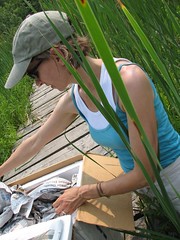
In exchange for helping collect data from the monitoring plots, I got to oberve, photograph insects for the Life on the Purple Loosestrife project, get stung by a giant buck moth caterpillar(!), and see 7,500 Galerucella beetles get released in a wetland in Cutler Park, located along the Charles River in Dedham, MA.
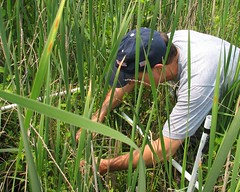
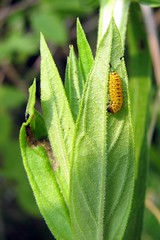
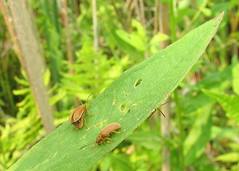
Galerucella are in the leaf beetle family (Chrysomelidae) and will munch on any of the above-ground loosestrife vegetation. To the right is a Galerucella larva that Damon found on the back of a purple loosestrife leaf - he found egg clusters as well. The presence of larvae and eggs is a good indicator that the beetles released last year are reproducing in the wild.
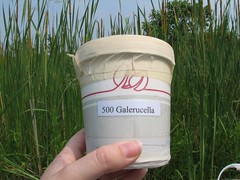
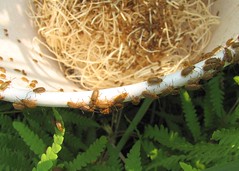
Beth set the buckets inside a few big patches of purple loosestrife and set the beetles free. The sight of two thousand beetles streaming out of a big bucket is pretty cool :-). Most of them headed upward (away from the bucket and probably towards the sunlight) as fast as they could.
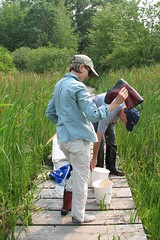
When all the Galerucella had emptied out of their containers, it was time to pack up and head home...but not before checking our boots and clothes for wayward beetles. Field workers and volunteers will return to check all the plots at the site again this fall.
Wednesday, June 27, 2007
Insects Aside
The Detroit Free Press has a report about efforts underway in Michigan to develop and release biological controls for the emerald ash borer (Agrilus planipennis). Two parasitic wasps, Tetrastichus planipennis and Oobius agrili, are being reared by entomologists at the U.S. Forest Service, who had hoped to start test releases of the insects this summer. However, the USDA has stepped in, requiring final authorization for the project and instituting a comment period so that the public can have their say. As of right now there is no set schedule for when (or indeed if) the project will proceed.
The public comment period ended about a week ago, but you can read the Environmental Assessment doc here (.pdf). The TreeNotes blog also has an excellent overview.
Saturday, June 16, 2007
On Their Gourds
According to this story in the Saipan Tribune, the island of Saipan is having a serious gourd problem. Seems the ivy gourd (Coccinia grandis) is spreading throughout the Pacific island, where it has only been known since 2001. While Saipan originally responded quite quickly to the invasion of this aggressive vine, by releasing the biocontrol weevil Acythopeus cocciniae, a typhoon killed a lot of them off back in 2004. Now new beetles are being reared on the island Guam and shipped to Saipan when they are ready to be released.
Bonus points to the Saipan Times for using scientific names (though the presence of so many presumed Coccina typos on the 'nets confounds me).
Thursday, December 07, 2006
Dingoes Ate Their Babies?
Interesting piece over at Cosmos Magazine (not to be confused with Cosmo!) titled "The Dingo Divide." It's about an effort underway by some researchers to encourage the use of the dingo (Canis lupus dingo) as a biological control for feral cats (Felis catus) and foxes (Vulpes vulpes) that roam Australia. These days, dingoes aren't very well-liked, and are often killed to keep them from attacking herds of sheep and cattle. But scientists say killing dingoes could be harming native biodiversity by reducing the numbers of one of the few predators remaining that can actually kill the foxes and cats. Complicating the situation is the fact that the dingoes themselves were also introduced to Australia, but being as that was about 4000 years ago, they seem to have seniority.
Is this a classic biological control case, or should the dingoes be considered a native and natural part of the Australian habitat? After you've chewed on that for a while, check out this great YouTube video of an invasive red fox grabbing (and then losing) a wallaby. It was both shot and sent in by Tom Rayner - Thanks Tom!
Friday, October 17, 2003
Fighting Fire with Fire
As reported by The Times of India, the Municipal Corporation of Hyderabad recently released 200,000 gambusia fish (Gambusia sp.) into India's Hussain Sagar Lake, in an attempt to control mosquito populations. Problem is that gambusia themselves are a known invasive species. But there continues to contraversy in India about the introduction: while some claim that the fish dine solely on mosquito larvae, others insist that the fish are a threat to the native flora and fauna of the lake. I'm a bit confused myself, since it appears Hussain Sagar Lake is a man-made body of water (though it is over 400 centuries old).
Thursday, June 27, 2002
Gambusia = Damnbusia
Check out the Gambusia Control Homepage. Dedicated to explaining to the world the problems caused by Mosquitofish, which has been used as a method of controlling mosquito larvae, the page points out that this genus threatens native biodiversity in Australia and New Zealand, and coyly renames the fish "damnbusia." The U.S. is also dealing with this problem genus, which is actually native to the southeastern states. Ironically, Mosquitofish do not even do a good job of mosquito larvae control.
Subscribe to:
Posts (Atom)