Zebra mussels, already in one Massachusetts lake, have now been found in the Housatonic River. A report detailing the finds also places ten other water bodies at high risk for invasion.
Showing posts with label Massachusetts. Show all posts
Showing posts with label Massachusetts. Show all posts
Friday, December 11, 2009

Monday, July 06, 2009
Mass Mussel Mania
Zebra mussels (Dreissena polymorpha) have been found for the first time in the state of Massachusetts. The mussels were found by an alert citizen swimming in Laurel Lake in the town of Lee, located in the western part of the state.
Friday, October 24, 2008
A Wild Boah
According to this story in the Worcester Telegram, a wild boar (Sus scrofa, feral pig) was discovered along a highway in Massachusetts earlier this week. A police officer found the animal, which was seriously injured (presumably struck by a vehicle), and a decision was made to euthanize it. This is only the third record of a wild boar ever found in the wild in Massachusetts. States with established populations include California, Florida, Pennsylvania, and Texas.
Tip of the virtual hat to Universal Hub for posting a link to this story. Additional coverage is available from the Boston Globe.
Sunday, October 19, 2008
Weekend Photoblogging

Japanese hops
Originally uploaded by urtica
I remember passing by this plant in Boston this past spring and just stopping and staring. The vine had pretty much taken over the raised bed it was in, except for the tree in the center. First time I have ever seen the invasive Japanese hops (Humulus japonicus), live and in person, and it was in the middle of one of the most pavement-locked parts of the city. Not sure how it got there, but the bed was cleared a few weeks later and the hops didn't come back (it's an annual plant).
Thursday, August 07, 2008
Mass Beetle
The Asian longhorned beetle (Anoplophora glabripennis) was discovered last week in Worcester, Massachusetts, the first sighting of the species in Massachusetts (or in any of New England). Taking calls all day from concerned folks has got me beat, so rather than generating new content here, I'm going to be lame and link to this pest alert, and also decent coverage of the story from NECN.
If you think you have seen an Asian longhorned beetle in Massachusetts, I encourage you to submit a report (and maybe a photo) on the Massachusetts Introduced Pests Outreach Project website.
Update 8/8/08: The ALB has been "rediscovered" in Chicago - just a single specimen - calling the declaration of eradication into question. Scientists are not sure yet if this is a new infestation. Read more from the Chicago Tribune.
Sunday, June 15, 2008
Pontificating On Perennial Pepperweed
Found an interesting article in the Boston Globe about the perennial pepperweed (Lepidium latifolium) invading coastal wetlands in Massachusetts. It details ongoing efforts by the Parker River National Wildlife Refuge to protect wetland habitat from invasive plants while also engaging local volunteers in the project. And oh, look, they've quoted some smart biologist in the article! ;-)
Monday, May 26, 2008
Lessoning Loosestrife
From a meeting I recently attended comes news that Mass Audubon has developed "Lessoning Loosestrife," a standards-based curriculum that deals specifically with purple loosestrife (Lythrum salicaria) and its impact on wetlands. They have even released the lessons online so that others can download the files for free. Topics range from wetland monitoring to the use of beetles as a biological control for the loosestrife. The project was funded by a grant from the National Fish and Wildlife Foundation, so it's really nice to see the results shared with others who might be interested in incorporating this into their own curricula.
Bonus points to Mass Audubon for using a punny title, making my job here so much easier ;-).
Monday, May 12, 2008
Postal Service
In case you are wondering why the posts aren't quite so "daily" here at the ISW, it is because I have a new job that came with a new website and I have been blogging a bit over there. The Massachusetts Introduced Pests Outreach Project is, as you can guess, focused on the state of Massachusetts, so the flavor of the posting there is decidedly New England-centric. Feel free to stop by.
Sunday, May 11, 2008
Fun With Weeding
In my yard today...
- Pulled: 20 Norway maple seedlings (Acer platanoides)
- Cut: 7 Norway maple saplings/suckers (note to self: get Weed Wrench!)
- Severed: 5 Asiatic bittersweet vines (Celastrus orbiculatus)
- Spared (from said bittersweet vines): 2 cherries, 2 maples, 2 dogwoods, 1 sassafras
- Eyed with disdain: blackberry lily (Belamcanda chinensis) growing in my compost pile
Monday, April 21, 2008
Weekday Photoblogging
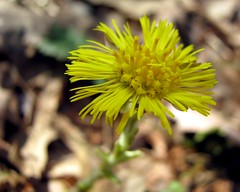
Yellow Mess
Originally uploaded by urtica
In a midst of green and brown, a bright yellow flower caught my eye...and turned out to be coltsfoot (Tussilago farfara). When you're out in the woods looking for signs of spring, this isn't really what you're hoping for. Especially when you've been passing by the same spot on the trail for three years and have never seen a leaf nor a fluffy seed head belonging to this forest invader.
I yanked it out - hope there aren't more where this came from
Tuesday, November 27, 2007
Motherland
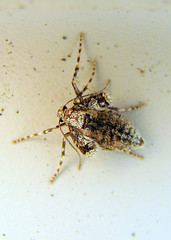
It's that time of year again! A lot of people have been stopping in at the ISW lately, following Google searches for some variation of the phrase "European winter moth." Sure enough, there are moths out and about in Massachusetts, though it is tricky to tell apart the three winter flyers we get: the European winter moth (Operophtera brumata) and the native Bruce spanworm moth (Operophtera bruceata) and fall cankerworm moth (Alsophila pometaria). For your convenience, I present the following links:
- The UMass Extension web page "Identifying and Managing the Life Stages of Winter Moth" - in my opinion the best reference available on the web.
- Previous ISW posts about the winter moths.
Sunday, November 18, 2007
Weekend Photoblogging
Euonymus gone astray - this is a photo collage of an introduced Euonymus, naturalized in Canton, Massachusetts. I was lucky enough to get a tour of the site a couple of weeks ago.
The jury is not yet in on whether this is E. planipes or E. sachalinensis. The fruits were odd in that the number of locules (chambers) they contained varied, even on the same plant, between four and five.

The jury is not yet in on whether this is E. planipes or E. sachalinensis. The fruits were odd in that the number of locules (chambers) they contained varied, even on the same plant, between four and five.
Monday, September 03, 2007
Weekend Blog Blogging (Labor Day Edition)
The past week in invasive species blogging...from other people's blogs:
- Walking the Berkshires has an interesting post about the invasive status of horned poppy and rugosa rose in Massachusetts.
- The Natural Patriot notes the irony in the recent news that house sparrows and starlings are endangered in the UK.
- Roebrt Emanuel at H2ONCoast writes about the Japanese knotweed in bloom in Oregon.
Friday, August 31, 2007
Tower Power
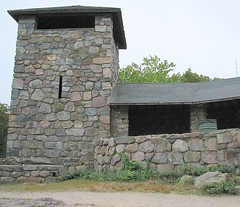
Last week I met up with some folks from Friends of the Blue Hills (FBH) to help plan a cleanup day they've scheduled at Eliot Tower. Eliot Tower is an observation tower located at the top of Great Blue Hill in the Blue Hills Reservation in southeastern Massachusetts. It's at an elevation of about 635ft and affords an excellent view of the surroundings.
Since the Reservation is state-owned property, FBH needed to coordinate their cleanup efforts with the Massachusetts Department of Conservation and Recreation. Eliot Tower is a historic building so the Friends are fairly limited in what they can do to fix things up. One of the possibilities was the removal of invasive plants, and I was asked to assess the site for possible management opportunities.
I knew beforehand that two common invaders were there: black swallowwort (Cynanchum louiseae) and Asiatic bittersweet (Celastrus orbiculatus). Upon arriving at the Tower (okay, fine, upon catching my breath following a steep climb!) I did a quick survey of the area. The wall around the building was dotted with Asiatic bittersweet, black swallowwort, and a bunch of other native and introduced plants:
That seemed manageable! Adjacent to the tower were a few picnic tables, and next to that was more black swallowwort:
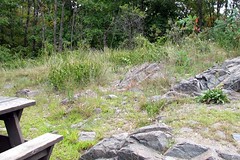
Those patches didn't seem that bad, and there was a nice population of native blue curls (Trichostema dichotomum) right nearby - it would be good to get rid of the invader there!
The Massachusetts Natural Heritage & Endangered Species Program classifies the area around Eliot Tower as Acidic Rocky Summit. There is no real canopy there, just a lot of exposed rock and some herbs, grasses and shrubby things where the soil is found. It's dry, too, as you can probably tell from the photos - the black swallowwort is looking pretty wilty. Around the margins of the rocky open area is a mixed oak/hickory forest, with some cherry trees along the very edge:
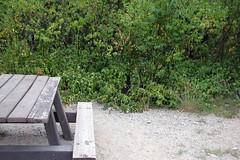
This still didn't look that bad, if the black swallowwort was just along the edge of the forest canopy. Then I turned to my right, and the true extent of the black swallowwort invasion began to take shape:
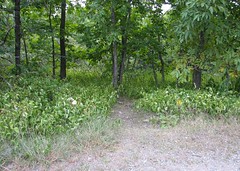
The vine has almost completely taken over the forest understory! It reaches back as far as the eye can see in the shot above. It also dominates the edges of the trail shown here:
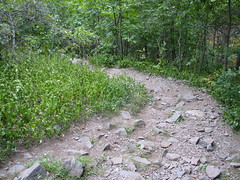
I am not sure when black swallowwort first arrived on Great Blue Hill, but it looks like it is there to stay, for now anyway. I feel particularly bad for these two false Solomon's seal plants (Maianthemum racemosa), holding on for dear life in a sea of swallowwort (while the swallowwort holds on to them!):
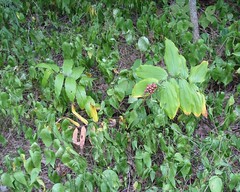
It is sad to see this part of the Blue Hills Reservation lose so much of its character. Gone are most of the goldenrods, asters, and other native herbs, replaced by a monotonous view of a single, invasive species.
So what do you tell a group of volunteers eager to help clean up a site like this? A management plan to combat black swallowwort around Eliot Tower would need to go far beyond teams periodically hand-pulling the vines. For now, Friends of the Blue Hills will likely just focus their efforts on improving the physical aspects of the site (cleaning up trash and other tasks). While they could take this opportunity to do some outreach and remove the invasive plants from the perimeter of the building, but there is no practical way to prevent the black swallowwort from reinvading when it is so pervasive in the surrounding habitat. Prognosis: not good...unless you're black swallowwort.
Friday, July 13, 2007
New Zoo Revue
Does being a blogger have its privileges? Perhaps. Last weekend, for example, I managed to use some connections to wrangle my way into the Franklin Park Zoo to see their cordoned-off giraffe exhibit up-close, under the guise of doing some invasive species reporting for the blog.
Actually, the trip was part of the massive knotweed extravaganza I was treating visiting photographer Koichi Watanabe to, in an effort to show him Japanese knotweed in Massachusetts in as many different habitats as possible. I had heard from a colleague a while ago that the Franklin Park Zoo was feeding knotweed to one of its giraffes, and the Roger Williams Zoo feeds it to their animals too, but I wanted to know more about it. Having Koichi here seemed like the perfect opportunity to find out.
So last Saturday my husband and I picked up Koichi, and the three of us met up with the Executive Director of the Franklin Park Coalition, Christine Poff, and active member Allan Ihrer. Before we headed to the zoo, Christine and Allan gave us a nice tour of the park...and when I say "nice" I mean "we saw so many different invasive plants my head was spinning" :-). There were a lot of native plants there too, and all in all the park is quite nice - I will definitely be heading back there for more visits this summer.
At noon Christine begged off, and the rest of our group headed over to the zoo and met up with Pearl Yusuf, the assistant curator for "Hooves and Horns." She took us down to the giraffes - surprisingly, through a locked gate! It turns out that the giraffe exhibit is currently under construction, and the public can only view the giraffes from afar. We lucked out and got to go right up to their pen.
There was already a bucket of fresh knotweed stems waiting nearby, next to a big pile of bundled dead stems, all of their leaves stripped off by hungry giraffes. Pearl started off by explaining the story behind the use of Japanese knotweed at the zoo. The zoo had been feeding knotweed to some of the animals for several years, as a treat. Then their male giraffe, Beau, developed a wasting disease, and turned down all kinds of food, until the Japanese knotweed finally perked his appetite back up. Since then, zookeepers have continued to feed knotweed to most of the hoofed animals at the zoo.


Some of you are probably wondering whether Japanese knotweed provides the animals with a balanced diet...Allan in fact asked that very question. It turns out that it is not meant to - it is meant to provide a source of forage for the hoofed animals, ruminants who need a constant source of forage to keep their stomachs full and properly digest their food.
The giraffes are also fed a fortified food made with grains, alfalfa and beet pulp, to meet their main nutritional needs. That is what is in those red buckets hanging on the fence in the photo to the right.
So where is all this Japanese knotweed coming from? Much of it is cut right from the adjacent Franklin Park. Lucky for the zoo, the park is infested with the stuff. That is where the Franklin Park Coalition comes in. Christine organizes teams to harvest the knotweed and the zoo comes by and scoops up piles of it to bring to the animals. They even end up freezing a lot of it so that they can continue to feed it to the giraffes through the winter months. Oddly, Beau loses his taste for Japanese knotweed around when it starts to flower, but will start eating it again at the end of the season after it has gone to seed. His mate, Jana, and their daughter, Autumn, aren't quite as picky.
A lesser news source might try to take the angle that this is going to solve the problem we have with invasive Japanese knotweed. But in reality, this isn't likely to make even the slightest dent in wild knotweed populations. In fact, the giraffes are fairly particular about how they'll eat it, and prefer long stems bundled together to mimic tree branches. To reduce Japanese knotweed growth in the wild by cutting, it has to be done several times per season, otherwise the rhizome biomass (the underground stems where the plant's resources are stored) would not be impacted. That would result in short, shrubby knotweed, something the giraffes would probably turn up their noses at.
But hey, if anyone knows where I can get a pet giraffe, we've got all this Japanese knotweed around, we might as well use it for something (they like autumn olive too!).
Tuesday, July 10, 2007
Photo Synthesis
You can now access the full gallery of photos from my visit to Cutler Park, site of a release of Galerucella beetles as a biological control for purple loosestrife (Lythrum salicaria). There are lots of photos of beetles and other creatures on purple loosestrife and also many images of the native wetland flora in the park. All 61 photos are covered under a Creative Commons license, which means they are free to use for non-commercial purposes, provided I am credited as the photographer.
Sunday, July 08, 2007
I am in your zoo, eatin' your knotweeds!

This is Beau the giraffe, munching on knotweed at the Franklin Park Zoo. A full blog post is coming soon!
Friday, July 06, 2007
Stalking The Wild Itadori
Tomorrow I am lucky enough to be playing guide to Koichi Watanabe, a photographer from Japan, who has come to Massachusetts to see Japanese knotweed (Fallopia japonica, Polygonum cuspidatum, Reynoutria japonica, etc. etc.). Of course, Japanese knotweed is from Japan, so why come here? Koichi has been traveling all over the world to photograph this invasive plant in a variety of locations and habitats. I'll be taking him on the grand tour, including stops at UMass Boston (where the knotweed grows in pots! :-)), Franklin Park (where the Franklin Park Coalition will be our guides), and sites in Metrowest Massachusetts where giant knotweed (Fallopia sachalinensis) and hybrid knotweed (Fallopia x bohemica) grow. While Koichi is honing his craft, I'll be collecting photos for the Life on the Japanese Knotweed project. Hopefully, when we get back, I'll also have photos of some giant beasties munching on knotweed...stay tuned! (Hint)
If you'd like to see some of Koichi's work, check out his his website, which includes an explanation of his search for "itadori."
Monday, July 02, 2007
Bustin' Loosestrife
Last Wednesday I headed out into the field to help out with the Massachusetts Purple Loosestrife Biocontrol Project, headed by Beth Suedmeyer of the state's Wetland Restoration Program. Galerucella beetles are currently being used in many parts of the USA to control populations of the invasive wetland plant purple loosestrife (Lythrum salicaria). The beetles, which were discovered in loosestrife's native range of Europe, were selected for rearing here in the USA because of their propensity to dine almost exclusively on purple loosestrife. Massachusetts has had an active beetle release program for several years now (see this ISW post describing my visit to a project site with Fred SaintOurs, back in 2004).
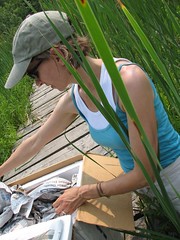
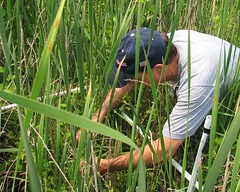
In exchange for helping collect data from the monitoring plots, I got to oberve, photograph insects for the Life on the Purple Loosestrife project, get stung by a giant buck moth caterpillar(!), and see 7,500 Galerucella beetles get released in a wetland in Cutler Park, located along the Charles River in Dedham, MA.
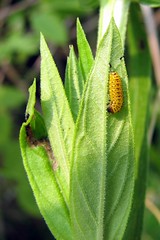
Galerucella are in the leaf beetle family (Chrysomelidae) and will munch on any of the above-ground loosestrife vegetation. To the right is a Galerucella larva that Damon found on the back of a purple loosestrife leaf - he found egg clusters as well. The presence of larvae and eggs is a good indicator that the beetles released last year are reproducing in the wild.
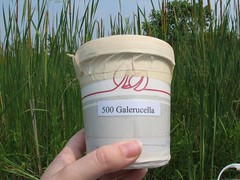
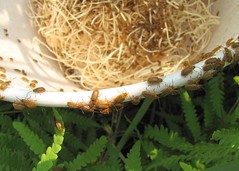
Beth set the buckets inside a few big patches of purple loosestrife and set the beetles free. The sight of two thousand beetles streaming out of a big bucket is pretty cool :-). Most of them headed upward (away from the bucket and probably towards the sunlight) as fast as they could.
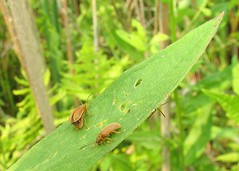
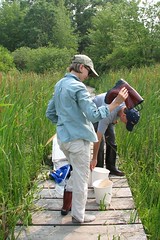
When all the Galerucella had emptied out of their containers, it was time to pack up and head home...but not before checking our boots and clothes for wayward beetles. Field workers and volunteers will return to check all the plots at the site again this fall.
Tuesday, June 19, 2007
New And Notable
Recent new arrivals in the USA, courtesy of the USGS Nonindigenous Aquatic Species Alert System:
- The brittle naiad, Najas minor, has been reported for the first time in South Dakota, in a lake it has probably been hanging around in since 2003.
- A Nile tilapia (Oreochromis niloticus) was discovered in the Charles River in Massachusetts. Must have been checking out a free concert, as it was found near the Hatch Shell. The person who discovered it claims he saw more of them in 2006. Uh oh.
- Someone recorded the call of a Rio Grande chirping frog (Syrrhophus cystignathoides) in Louisiana. Normally this species is found only in Southern Texan and Northern Mexico. A range expansion perhaps?
- Puerto Rico has added yet another non-native aquatic plant to its flora: the white water lily (Nymphaea odorata).
Subscribe to:
Posts (Atom)