Showing posts with label winter moths. Show all posts

Tuesday, November 27, 2007

Motherland


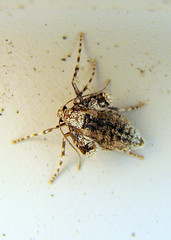
bug of the day - bonus!
Originally uploaded by urtica

It's that time of year again! A lot of people have been stopping in at the ISW lately, following Google searches for some variation of the phrase "European winter moth." Sure enough, there are moths out and about in Massachusetts, though it is tricky to tell apart the three winter flyers we get: the European winter moth (Operophtera brumata) and the native Bruce spanworm moth (Operophtera bruceata) and fall cankerworm moth (Alsophila pometaria). For your convenience, I present the following links:

Saturday, December 02, 2006

Moth Balls: Update

Back in July 2006 the ISW reported about a program at UMass Amherst to develop a biological control for the European winter moth (Operophtera brumata). Short story is that the funding for the program was cut by Massachusetts Governor Mitt Romney, who indicated that UMass Amherst should pay for it themselves.

Since then, the State Legislature overrode Romney's veto and reinstated the funding, which was promptly cut again in November under the Governor's emergency spending powers. Now the researcher in charge of the project, Joseph Elkinton, is speaking out in this Boston Globe article, noting that he's lost funding he was already starting to spend. The Romney administration noted that since it gave UMass Amherst $30 million "extra" this year, the university should use that money to fund the project. Does this mean they are refusing to acknowledge that the European winter moth is a statewide problem? Will UMass pony up the money for Elkinton to finish his work, or will the incoming Patrick administration reinstate the separate funding? Only time will tell.

Friday, July 07, 2006

Moth Balls

Sorry, have to go off on a local rant here. Maybe folks from outside of New England will stick around just to sympathize...

[rant] Last month the Massachusetts legislature approved two big, fat, multi-million dollar pork-filled spending bills. In one of the bills was $150,000 earmarked for a program to develop a biological control program (.pdf) for the European winter moth (Operophtera brumata) that has been causing massive tree defoliations up and down the Massachusetts coast. The moth populations exploded a couple of years ago and have been gradually spreading inland (plenty of them last winter at my house in MetroWest Framingham).

My beef is not so much with Governor Romney's subsequent line item veto of the money, but the way it was handled. Here is Gov. Romney's response when asked about the veto:

"No one came up to me and said 'Hey look, this is so important,'" Romney said on Saturday. "If it's that important, UMass ought to be able to find a way to pay for that in their normal budget."

What an uninformed response! UMass Amherst and their Cooperative Extensions program have been at the forefront of educational outreach for the winter moth invasion since the problem first became known. They should be congratulated, not shamed. As Dr. Elkinton, the lead scientist for the proposed program, noted in an interview over at BostonChannel.com, "This is a threat to the entire state of Massachusetts." Implying that the program is something UMass Amherst should pay for is ridiculous.

As if Gov. Romney's response wasn't embarrassing enough, Boston Herald columnist Howie Carr had to get into the mix. From his June 28th column in the Boston Herald:

"But what’s Mitt supposed to do when they pass these lard-ridden budgets? Consider the $150,000 to UMass to study the winter moth. Out in Happy Valley, this is being portrayed as the new Manhattan Project, but the reality is, everything you need to know about moths can be summed up in two words.

Moth balls.

You buy enough moth balls, and you won’t have to worry about the winter moth, or the summer moth either, for that matter."

Wha??? Howie, please. It's one thing for the Governor to make an off-the-cuff snide remark, but if you're going to write about a topic in your column, please do some fact-checking. The fumes from moth balls only work if they can build up inside sealed containers. They aren't going to do a darned thing for the winter moth caterpillars devouring your trees. I found this out in five minutes with some help from Google, apparently more effort than you were willing to put into learning about it.

With over $200 million in pork projects, why is the winter moth being scapegoated? Maybe because the impact of the moth isn't being felt that far inland yet. The Senator and Representative that earmarked the money are from coastal towns of Gloucester and Falmouth, respectively. I have a feeling when people in Wellesley (Howie!) and Belmont (Mitt!) start noticing that none of their trees have leaves, and their houses and cars are covered in caterpillar poop, they will start paying attention. That shouldn't be too long from now, since we're already seeing high numbers of moths inland. Unfortunately, repeated defoliation of trees leads to...you guessed it: tree mortality. Winter moths aren't picky either - they'll go for oaks, maples, cherries, and even spruce trees.

The extent of the invasion and the difficulty in distinguishing the European winter moth from several similar but native species means that the chance of eradicating them, if it was ever possible, has long since passed. Perhaps a biological control program modeled after successful programs in Canada is exactly what we should be aiming for. [/rant]

The ISW previously blogged about the European winter moth in April 2005 and May 2003.
Saturday, April 02, 2005

We Don't Need No Defoliation

The noises you're hearing are the cries of thousands of Massachusetts homeowners and the entire Mass. Department of Conservation and Recreation. They've all read an article similar to this one from The Upper Cape Codder, about how we should expect at least 5 years of massive tree and shrub defoliation due to the invasion of the European winter moth (Operophtera brumata). After that, scientists are hoping that they will be ready to release populations of a biological control (Cyzenis albicans) to keep the moth in check. Check out the article for information about uncovering signs of winter moth infestations and tips on how to protect trees.

In a few weeks, anyone that saw massive congregations of moths at their porch light this winter (mostly southeastern Massachusetts) is likely to be inundated by tiny, hungry caterpillars. They don't seem very picky about what they eat so most plants will be vulnerable. You can read more about the history of this invader from UMass Extension.

Bonus points to the Mass. media for keeping the scientific name of the moth in their articles.

Saturday, December 27, 2003

The moths return

The winter moths are back in southeast Massachusetts, along with the confusion over their origin. The Boston Globe is reporting that the tiny brown moths (they're actually a pretty copper color up close) are covering people's houses by the hundreds. Scientists are unsure whether the moths have migrated from Canada or are actually native to Europe. Their populations appeared to have died off over the past few days, based on accounts in the Globe article, and the fact that my parent's house in Randolph had a mere 25 under the porch light on Christmas day. The ISW had an entry about 2002's moth invasion earlier this year, along with a photo.

Friday, May 16, 2003

Moth Mania
image of winter moth

Last December I observed a massive moth invasion in my hometown of Randolph, Massachusetts. There were thousands of moths swarming all over the place, so I grabbed one and took some photos. Now comes this story from WBZRadio.com, about the sudden invasion of inchworms defoliating the trees. It turns out these are likely the offspring of the same European winter moths (Operophtera brumata), though the species can be confused with the fall cankerworm (Alsophila pometaria). The distinct fringes along the wings and the fact that I caught this moth in December make me think that the photo above is the winter moth, but I can't be sure. You can read more about the moths and the expected extent of invasion here.