A European grapevine moth (Lobesia botrana) has been found in Napa Valley, California, the first find of this pest in the USA (via InvasiveInfo).
Showing posts with label moths. Show all posts
Showing posts with label moths. Show all posts
Tuesday, October 13, 2009

Friday, June 20, 2008
Spray Canned
The Mercury News, among others, is reporting that plans for the spraying of pheromones to combat the light brown apple moth (Epiphyas postvittana, or "LBAM") in northern California were scaled back. The change follows a public outcry and concern that the chemicals in the spray could cause harm to human health. The California Department of Food and Agriculture will instead focus the aerial spraying program mainly agricultural and undeveloped, and will continue to use the pheromone to thwart the LBAM through manually applied lures. In addition, the CDFA is ramping up a program to release sterile male moths that will begin in 2009.
Thursday, April 24, 2008
No Spray Zone?
Looks like the Governor of California [trying...so...hard...not to say...THE GOVERNATOR...oh well] is taking the claims of health risks associated with pheromone spraying for the light brown apple moth seriously. The Almanac, among others, is reporting that following the court decision banning spraying in Santa Cruz County, all aerial spraying for LBAM (Epiphyas postvittana) in the state of California will cease until at least mid-August, so that thorough testing can be done to inform the government of the safety (or lack thereof) of the process.
Monday, March 10, 2008
How Do Ya Like Them Apple Moths?
California media outlets were abuzz today with news of a new study claiming that the light brown apple moth (Epiphyas postvittana) is not likely to become a pest in the USA. The researchers visited New Zealand and reviewed data from that country, where the LBAM has been around for over a century and currently does little damage to crops, living in sync with native predators since widespread spraying of pesticides stopped several decades ago. The report also concludes that the controversial aerial spraying of pheromones to trap the moths is unlikely to work in California.
With all that media coverage, it was still frustratingly hard to track down the actual study, but here it is (pdf), courtesy of the California Progress Report. Go read it for yourself.
Tuesday, February 12, 2008
Blasted Cactoblastis!
Monique R. wrote in to point out this recent posting in the US Federal Register regarding the South American cactus moth (Cactoblastis cactorum). The USDA has just opened up a public comment period soliciting opinions about an effort to protect the central and western parts of the USA from the negative impact that cactus moths can have on prickly pear cacti (Opuntia spp.) and their cactus relatives (Consolea spp., Cylindropuntia spp., Nopalea spp.). Along with a control program where sterile cactus moths will be released into the wild, the USDA is proposing a four-state quarantine zone (Alabama, Florida, Georgia, and South Carolina) from which interstate movement of the cactus genera listed above would be prohibited. Anyone interested in commenting on this issue can do so up until April 11, 2008.
Tuesday, January 29, 2008
Retreat, Regroup, Reformulate
The Californian is reporting that their state's Department of Agriculture has stopped spraying for the light brown apple moth (Epiphyas postvittana, or LBAM)...for now. The halting of the aerial applications of moth pheremones are in part due to the many complaints received from California residents concerned with the potential human health impacts of the chemicals. The USDA is currently seeking a longer-lasting formulation of the spray that won't need to be applied as frequently, and will work with the CDAR to come up with a new management plan for the LBAM once their investigation is complete.
For more background from the ISW on the LBAM invasion in California, click here.
Tuesday, November 27, 2007
Motherland
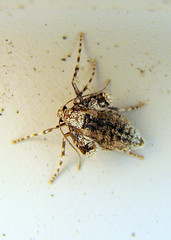
It's that time of year again! A lot of people have been stopping in at the ISW lately, following Google searches for some variation of the phrase "European winter moth." Sure enough, there are moths out and about in Massachusetts, though it is tricky to tell apart the three winter flyers we get: the European winter moth (Operophtera brumata) and the native Bruce spanworm moth (Operophtera bruceata) and fall cankerworm moth (Alsophila pometaria). For your convenience, I present the following links:
- The UMass Extension web page "Identifying and Managing the Life Stages of Winter Moth" - in my opinion the best reference available on the web.
- Previous ISW posts about the winter moths.
Sunday, November 04, 2007
Weekend Blog Blogging
The past week in invasive species posts, from elsewhere in the blogosphere:
- Sifolinia takes a break from ant blogging to pick up some Asian lady beetles, and ponders whether it is already a lost cause.
- Even more about the light brown apple moth, this time from 0tt's livejournal.
- Walking is Transportation posts about a new path that's as good for walkers as it is bad for invaders.
Wednesday, October 17, 2007
Let Us Spray?
Should the state of California be allowed to commence aerial spraying in order to combat the light brown apple moth (Epiphyas postvittana)? Some concerned citizens are saying no loud enough to be heard. The California Farm Bureau Federation is reporting that plans to spray a pheremone over infested portions of the central coast of California have hit a few roadblocks as objections were raised about whether polymethylene polyphenyl isocyanate, an inert ingredient in the spray, might be hazardous. Lawsuits at both the city and county level have put some treatments on hold, while the California Department of Food and Agriculture continues to hold meetings to inform the public about their management plans.
Readers interested in the subject of the "LBAM" should check out this previous ISW post on the subject. It has generated quite a few comments (by the ISW's meager standards, anyway).
Wednesday, August 29, 2007
Robin Hood And His Merry Moths
Sherwood Forest, one of several purported homes of Robin of Loxley (Robin Hood), is currently under threat by not one, but two different introduced moth species. According to this report at BBC News, the oak processionary moth (Thaumetopoea processionea) and the brown tail moth (Euproctis chrysorrhoea), introductions from Europe, are now both established in England. Biologists are quite concerned about the potential impact on the ancient oaks of Sherwood Forest if the moths arrive there. There is an attempt underway to manage the brown tail moth populations in nearby locations using pheremone traps...not sure what they're doing about the processionary moths though.
Wednesday, April 25, 2007
Viva La LBAM!
According to this press release, the California Department of Food and Agriculture has just instituted a quarantine zone covering almost 200 square miles in an effort to combat the spread of the light brown apple moth (Epiphyas postvittana). The Australian moth, which was first discovered in California last month, is known to have caterpillars that feed on more than 250 different plant species, including, as it name suggests, apple and other trees in the rose family (peaches, plums, cherries and more). The quarantine covers the movement of any nursery stock and all fruits and veggies from areas including Marin County, Santa Clara County, and parts of San Francisco, and is expected to expand based on recent discoveries of new infestations. The CDFA has detailed maps (.pdf) of the quarantine regions but I can't seem to find a nice statewide map showing the spread.
Thursday, December 21, 2006
Cacto Blasters
The San Antonio Express-News is reporting that concerned scientists have put out an alert asking Texas landowners to keep a lookout for the invasive cactus moth (Cactoblastis cactorum) whose arrival in Texas is apparently imminent. The moth, which originates from South America, is a threat to native prickly-pear cacti (Opuntia spp.), and in fact has been used as a biological control in other parts of the world where prickly-pear cacti are considered invasive. Cactus moths were discovered in the U.S. in the late 1980s, and have been spreading both from Florida westward and from Mexico northward. If you're in Texas and you think you've spotted the moths or the caterpillars of this species, you should contact Texas Cooperative Extension (I can't find a related webpage - more information can be found here (.pdf), or call Barron Rector at 979-845-2755).
Saturday, December 02, 2006
Moth Balls: Update
Back in July 2006 the ISW reported about a program at UMass Amherst to develop a biological control for the European winter moth (Operophtera brumata). Short story is that the funding for the program was cut by Massachusetts Governor Mitt Romney, who indicated that UMass Amherst should pay for it themselves.
Since then, the State Legislature overrode Romney's veto and reinstated the funding, which was promptly cut again in November under the Governor's emergency spending powers. Now the researcher in charge of the project, Joseph Elkinton, is speaking out in this Boston Globe article, noting that he's lost funding he was already starting to spend. The Romney administration noted that since it gave UMass Amherst $30 million "extra" this year, the university should use that money to fund the project. Does this mean they are refusing to acknowledge that the European winter moth is a statewide problem? Will UMass pony up the money for Elkinton to finish his work, or will the incoming Patrick administration reinstate the separate funding? Only time will tell.
Monday, September 04, 2006
Moth Rah
ARS News is reporting that scientists may have found a better way to control the cactus moth (Cactoblastis cactorum), a South American insect that preys upon various species of prickly pear cacti (Opuntia spp.).
While there has been some success with releasing sterile male moths into wild populations (sterile insect technique, or SIT), irradiating the males to the point of sterility also left them lazy and less likely to compete with non-sterile males for a mate. Results have shown that dosing the moths with a lower level of radiation gave scientists what they needed: male moths with reduced fertility, rather than sterility, that are much more interested in finding a mate and produce sterile offspring. Field tests for this technique are currently going forward on an island in Alabama, the outermost edge of the moth invasion, which has gradually been spreading from South America up into U.S. territory.
Interested readers may also want to check out previous ISW posts about the cactus moth.
Friday, July 07, 2006
Moth Balls
Sorry, have to go off on a local rant here. Maybe folks from outside of New England will stick around just to sympathize...
[rant] Last month the Massachusetts legislature approved two big, fat, multi-million dollar pork-filled spending bills. In one of the bills was $150,000 earmarked for a program to develop a biological control program (.pdf) for the European winter moth (Operophtera brumata) that has been causing massive tree defoliations up and down the Massachusetts coast. The moth populations exploded a couple of years ago and have been gradually spreading inland (plenty of them last winter at my house in MetroWest Framingham).
My beef is not so much with Governor Romney's subsequent line item veto of the money, but the way it was handled. Here is Gov. Romney's response when asked about the veto:
"No one came up to me and said 'Hey look, this is so important,'" Romney said on Saturday. "If it's that important, UMass ought to be able to find a way to pay for that in their normal budget."
What an uninformed response! UMass Amherst and their Cooperative Extensions program have been at the forefront of educational outreach for the winter moth invasion since the problem first became known. They should be congratulated, not shamed. As Dr. Elkinton, the lead scientist for the proposed program, noted in an interview over at BostonChannel.com, "This is a threat to the entire state of Massachusetts." Implying that the program is something UMass Amherst should pay for is ridiculous.
As if Gov. Romney's response wasn't embarrassing enough, Boston Herald columnist Howie Carr had to get into the mix. From his June 28th column in the Boston Herald:
Moth balls. You buy enough moth balls, and you won’t have to worry about the winter moth, or the summer moth either, for that matter.""But what’s Mitt supposed to do when they pass these lard-ridden budgets? Consider the $150,000 to UMass to study the winter moth. Out in Happy Valley, this is being portrayed as the new Manhattan Project, but the reality is, everything you need to know about moths can be summed up in two words.
Wha??? Howie, please. It's one thing for the Governor to make an off-the-cuff snide remark, but if you're going to write about a topic in your column, please do some fact-checking. The fumes from moth balls only work if they can build up inside sealed containers. They aren't going to do a darned thing for the winter moth caterpillars devouring your trees. I found this out in five minutes with some help from Google, apparently more effort than you were willing to put into learning about it.
With over $200 million in pork projects, why is the winter moth being scapegoated? Maybe because the impact of the moth isn't being felt that far inland yet. The Senator and Representative that earmarked the money are from coastal towns of Gloucester and Falmouth, respectively. I have a feeling when people in Wellesley (Howie!) and Belmont (Mitt!) start noticing that none of their trees have leaves, and their houses and cars are covered in caterpillar poop, they will start paying attention. That shouldn't be too long from now, since we're already seeing high numbers of moths inland. Unfortunately, repeated defoliation of trees leads to...you guessed it: tree mortality. Winter moths aren't picky either - they'll go for oaks, maples, cherries, and even spruce trees.
The extent of the invasion and the difficulty in distinguishing the European winter moth from several similar but native species means that the chance of eradicating them, if it was ever possible, has long since passed. Perhaps a biological control program modeled after successful programs in Canada is exactly what we should be aiming for. [/rant]
The ISW previously blogged about the European winter moth in April 2005 and May 2003.
Saturday, April 02, 2005
We Don't Need No Defoliation
The noises you're hearing are the cries of thousands of Massachusetts homeowners and the entire Mass. Department of Conservation and Recreation. They've all read an article similar to this one from The Upper Cape Codder, about how we should expect at least 5 years of massive tree and shrub defoliation due to the invasion of the European winter moth (Operophtera brumata). After that, scientists are hoping that they will be ready to release populations of a biological control (Cyzenis albicans) to keep the moth in check. Check out the article for information about uncovering signs of winter moth infestations and tips on how to protect trees.
In a few weeks, anyone that saw massive congregations of moths at their porch light this winter (mostly southeastern Massachusetts) is likely to be inundated by tiny, hungry caterpillars. They don't seem very picky about what they eat so most plants will be vulnerable. You can read more about the history of this invader from UMass Extension.
Bonus points to the Mass. media for keeping the scientific name of the moth in their articles.
Saturday, December 27, 2003
The moths return
The winter moths are back in southeast Massachusetts, along with the confusion over their origin. The Boston Globe is reporting that the tiny brown moths (they're actually a pretty copper color up close) are covering people's houses by the hundreds. Scientists are unsure whether the moths have migrated from Canada or are actually native to Europe. Their populations appeared to have died off over the past few days, based on accounts in the Globe article, and the fact that my parent's house in Randolph had a mere 25 under the porch light on Christmas day. The ISW had an entry about 2002's moth invasion earlier this year, along with a photo.
Friday, May 16, 2003
Moth Mania

Last December I observed a massive moth invasion in my hometown of Randolph, Massachusetts. There were thousands of moths swarming all over the place, so I grabbed one and took some photos. Now comes this story from WBZRadio.com, about the sudden invasion of inchworms defoliating the trees. It turns out these are likely the offspring of the same European winter moths (Operophtera brumata), though the species can be confused with the fall cankerworm (Alsophila pometaria). The distinct fringes along the wings and the fact that I caught this moth in December make me think that the photo above is the winter moth, but I can't be sure. You can read more about the moths and the expected extent of invasion here.
Friday, October 18, 2002
Cacti Attacked
Scientists are concerned that the cactus moth (Cactoblastis cactorum), which dines on virtually any species of prickly pear (Opuntia spp.), is spreading north and west through North America. According to this article from the Arizona Daily Star, the moth, which is native to South America, could be making its way to Arizona and Mexico, where prickly pear cactus is a significant part of the desert ecosystem and also an important agricultual crop. The cactus moth is actually considered one of the first successful biological controls, having been introduced to Australia in the mid-20th century to combat invasive patches of prickly pear cactus. It is now also a pest of native cacti in that country.
Subscribe to:
Posts (Atom)