This November, Brooklyn fashion designers and musicians are teaming up for Nutria-palooza!, a nutria-themed fashion show set to music. The show will feature clothing and jewelry made using the invasive rodent known as Nutria or "coypu" (Myocastor coypus), and at least one band will participate by wearing what they're calling "nutria-gangster" outfits.
Showing posts with label New York. Show all posts
Showing posts with label New York. Show all posts
Thursday, November 04, 2010

Tuesday, June 23, 2009
Rocky Horror
A guy in New York is celebrating today because his ginormous, so-ugly-its-cute pet snakehead fish, named "Rocky," has been given a reprieve by the NY Department of Environmental Conservation. As long as he applies for a permit (and pays the $500 permit fee), he can keep Rocky in a tank.
Wednesday, June 17, 2009
Tuesday, June 02, 2009
Talk About The Weatherfish
A new population of the Oriental weatherfish (Misgurnus anguillicaudatus) has been found in New York. While there was a population in western NY that has been known since 2005, the one discovered last May is located in the southeastern tip of the state, in the Dwaar Kill.
Sunday, November 30, 2008
Hunt-and-Peck
The Outdoors Blog has a post and pic of two wild boars (Sus scrofa, feral pigs) recently taken by hunters in Central New York. The New York Department of Environmental Conservation (NYDEC) is also in the midst of a cooperative effort with other agencies to remove the animals from Central NY, but notes that hunters taking out single hogs from a pack will cause the rest to scatter, making rounding them up even tougher for the DEC. The post has contact into in case you've seen (or hunted) a pig in that area and want to report it.
Thursday, January 17, 2008
Post, Nuclear
The Post-Standard is reporting that zebra and quagga mussels (Dreissena polymorpha and D. bugensis) were indirectly responsible for the shut-down of a nuclear power plant on three different occasions last September and October. The James A. FitzPatrick Nuclear Power Plant in New York relies on water intake pipes from Lake Ontario, which is inhabited by both mussel species. While the official cause of the shutdowns was wave action leading to the clogging of the intake pipes with the green alga Cladophora, the mussels are being blamed for the proliferation of algae since 1) they don't eat it 2) their filtering abilities are clearing up the lake, allowing sunlight to reach lower depths and spurring the production of more Cladophora and 3) their waste products act as fertilizer to further enhance algae production. Plant workers have responded by enhancing the screens and other contraptions in place to keep the intake pipes clear.
Update: In related news, the mussels discovered late last year in the Pueblo Reservoir in Colorado have turned out to be zebra mussels - a new species for that state. (If you follow the ISW Twitter feed, you found that out about six hours ago.)
(Tip of the virtual hat to the Protect Your Waters website for linking to the power plant story.)
Friday, December 14, 2007
New And Notable
The latest and greatest in species introductions:
- Sudden oak death (Phytophthora ramorum) was discovered in Lithuania, in nursery stock imported from Poland. The plants are under quarantine so hopefully the pathogen won't be sticking around.
- The Asian hornet Vespa velutina has been discovered in France. This hornet species is not much of a direct nuisance to humans, but unfortunately they like to eat honeybees.
- They've found another Chinese mitten crab (Eriocheir sinensis) in New York, second one ever.
- There are a bunch of new discoveries in Puerto Rico, and as usual, they sound like the selection you'd find at your local aquarium store:
- The sailfin molly (Poecilia latipinna)
- The blue gourami (Trichogaster trichopterus sumatranus)
- The African jewelfish (Hemichromis letourneuxi, id tentative)
- Also new to Puerto Rico: water spangles (Salvinia minima)
Sunday, November 04, 2007
Weekend Blog Blogging
The past week in invasive species posts, from elsewhere in the blogosphere:
- Sifolinia takes a break from ant blogging to pick up some Asian lady beetles, and ponders whether it is already a lost cause.
- Even more about the light brown apple moth, this time from 0tt's livejournal.
- Walking is Transportation posts about a new path that's as good for walkers as it is bad for invaders.
Friday, September 14, 2007
Cohabitatation
Could European fire ants (Myrmica rubra) and Japanese knotweed (Fallopia japonica, Polygonum cuspidatum, Reynoutria japonica, etc. etc.) be in cahoots to take over North America? Researchers from Skidmore College in New York are aiming to find out. After initial investigations revealed that the ants were dining on the nectar proffered along knotweed stems, via structures known as extrafloral nectaries, a biology professor and his students decided to look more closely at the relationship between these two non-native species. Now they're mapping knotweed and ant populations and doing some neat experiments, including wounding knotweed leaves to check whether the ants come to the plant's defense (they did!). News from Skidmore has the whole story.
Saturday, July 28, 2007
Weekend Photoblogging
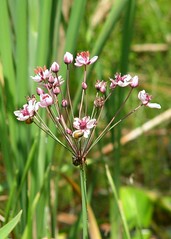
This is Flowering Rush - not really a rush in the true sense, as it is its own family, the Butomaceae, rather than the Juncaceae. But if you know the form that a rush takes you can see the resemblance, minus the showy pink flowers. Butomus umbellatus is an invasive species that has been on most of the state lists here in New England since the beginning, but I had never seen it before I walked by this one, part of a large patch next to Sapsucker Woods in New York.
Friday, July 27, 2007
EBB And Stow
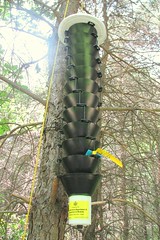
Last month while on our way back from a conference in New York, a group of us had the opportunity to stop at Schodack Island State Park. During our walk through the park we happened upon this odd contraption:
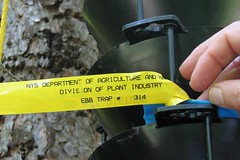
A closer inspection revealed this:
This is what is called a Lindgren Funnel Trap, a series of plastic funnels stacked together with the intent of catching insects and sending them down to a collection container at the base. The collector was filled with a blue liquid, probably ethylene glycol (antifreeze, a preservative), and the little blue package stuck in one of the funnels likely contained some kind of attractant, maybe even alpha-pinene, according to the Exotic Wood Borer Bark Beetle National Survey Field Manual put out by APHIS (pdf).
Turns out that the New York State Department of Agriculture and Markets has been monitoring for EBBs, or "Exotic Bark Beetles" at locations all over the state for several years now. They are on the lookout for anything from the pine shoot beetle (Tomicus piniperda) to longhorn beetles to non-beetle type of insects, including the European wood-boring wasp (Sirex noctilio) recently placed on Michigan's radar. It's good to know New York and other states have an early detection protocol for insects in place, so that we'll have a better chance at fending off that "Next Big Thing"...too bad a trapping system like this won't work for plants :-).
Friday, June 08, 2007
Mitten Mania
The Chinese mitten crab (Eriocheir sinensis) continues to make its mark on the east coast of the USA...just a few days after sightings were reported in both Maryland and Delaware comes news that the crab has been spotted in New York's Hudson River. This looks to be the first confirmed record of the species in New York state.
Meanwhile, The News Journal is reporting that three more of the mitten crabs have been caught in Delaware. The crabber who found them says he's been seeing them for years and throwing them back :-(.
Tuesday, March 20, 2007
No Beetle Is An Island
From USDA Newsroom comes this press release about the discovery of the Asian longhorned beetle (Anoplophora glabripennis, ALB) on a small island off the coast of New York. The infested maple and birch trees on tiny Prall's Island were found by USDA officials earlier this month during a routine inspection. The press release notes the beetles have likely been there at least one year. Following the discovery, Prall's Island and Staten Island have been added to the quarantine zone that already covers parts of New York and New Jersey, and all trees on the island with signs of ALB damage will be sent to the chippers.
Prall's Island was turned into a bird sanctuary back in the mid-1980s, and has no public access - so how did the beetles get there? As the nice map on this page from Wikipedia shows, the island is sandwiched right between New York and New Jersey, in Staten Island Sound (also known as the Arthur Kill). Now check out this map (pdf) showing the (now outdated) quarantine regions for New York and New Jersey. Prall's Island is off the map past the little bit of Staten Island that can be seen in the bottom left corner. Something tells me there are going to be more discoveries in that area over the next few months (and they're gonna need a bigger map!).
Update: The beetles have now been discovered on Staten Island. Xris at Flatbush Gardener has the details.
Monday, February 26, 2007
Shared Vision
How concerned is New York about the potential of the emerald ash borer (Agrilus planipennis, EAB) invading that state? So much that, according to this press release from the state Department of Agriculture and Markets, they're sending a team of foresters and horticultural inspectors down to Maryland to help survey ash trees for beetle infestations. While they are helping Maryland, the New Yorkers will also be gaining valuable experience in dealing with the EAB should it ever be detected in their home state. Reminds me of the way disaster response teams get sent out from across the country to deal with hurricanes and floods.
Tuesday, November 29, 2005
Native or Not: You Make the Call
Close on the heels of the eagle owl's return to England, the sea lamprey (Petromyzon marinus) has been officially named a Vermont Native. As reported by the Burlington Free Press, researchers have used molecular tools to conclude that the fish have called Lake Champlain home for at least 11,000 years, after migrating up the St. Lawrence River from the Atlantic Ocean. I wonder what the New York side of the lake thinks about this :-).
Wednesday, June 30, 2004
Water primrose primer
Workers at The Nature Conservancy's Long Island, NY chapter are spreading the word about the recent discovery of established populations of an invasive water primrose (Ludwigia sp.) in the Peconic River. A smart biologist has already documented the invasion with photos (see below). As reported by the ISW back in 2003, water primrose is prime mosquito habitat. If you're in the area and you think you've spotted this plant, you can find contact information for TNC's Long Island office here. TNC is considering their options for eradication or management as they study the situation more closely.


(Thanks to Andy Senesac for granting permission to use his photos.)
Thursday, July 24, 2003
Crabby Prison Inmate
According to this article from U.S. Newswire, a "former" fish importer in New York was just sentenced to 3 months in prison and fined more than $3000 for attempting to import 780 pounds of Chinese mitten crabs (Eriocheir sinensis). The boxes of crabs were labeled as fish, but someone tipped off wildlife inspectors to the ruse. Chinese mitten crabs are one of the few species whose import into the U.S. is prohibited under the federal legislation known as the Lacey Act.
Thanks to a member of the ALIENS-L listserver for posting a link to the article.
Saturday, July 19, 2003
Parsnippet
Giant hogweed (Heracleum mantegazzianum) may be getting most of the attention, but wild parsnip (Pastinaca sativa) is still a danger in its own right. The Daily Star is reporting that wild parsnip, also a danger due to its phototoxic sap, is spreading throughout Delaware County in New York. The plant does well along highways, not good news for road crews that can no longer spray herbicides.
Thursday, August 01, 2002
Yes, New York, there is a Sandy Claws
A former importer of seafood has been charged with illegally importing over a thousand Chinese mitten crabs (Eriocheir sinensis) into New York last year, according to this story posted at OnlineMariner.com. The crabs now thrive on the west coast of the U.S., but they have not yet established on the east coast. Though it is illegal to import the crabs for any reason other than scientific research, they have shown up in Chinese markets in Queens, New York, where they fetch a high price.
(Thanks to a member of the ALIENS-L listserver for posting a link to this article)
Subscribe to:
Posts (Atom)