The brown marmorated stink bug (Halyomorpha halys) has been discovered in Michigan.
Showing posts with label Michigan. Show all posts
Showing posts with label Michigan. Show all posts
Wednesday, February 02, 2011

Thursday, June 12, 2008
Weekday Blog Blogging
Some good invasive species posts have popped up in the blogosphere of late:
- bootstrap analysis has summaries of two recently published papers about invasive plants, one featuring garlic mustard (Alliaria petiolata) and the other featuring periwinkle (Vinca minor) - yes, periwinkle.
- The Lobster Fact Blog has a post about black tiger shrimp (Penaeus monodon) rediscovered off the coast of North Carolina. This is the second sighting in as many years in that part of the Atlantic. I don't get whether the LFB is a splog or not, but this is the first I've heard of the tiger shrimp invasion, so I'll link to them. Who knows, maybe I'll get a lobster-gram ;-). Thanks to Deb H. for sending this one in!
Saturday, February 09, 2008
Weekend Photoblogging
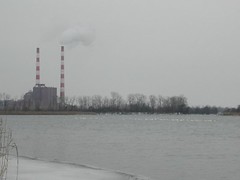
Mute swans, a whole lot of them. They're there, though you might have to click through to the photo page for confirmation.
Stylurus notes that "On December 28, 2004, we counted 590 individuals at this location."
(Thanks to Stylurus for allowing me to post this photo.)
Monday, November 05, 2007
Botox For The Birds
A story from the AP is suggesting that the recent swarm of bird deaths in Michigan are the indirect result of the proliferation of invasive species in the Great Lakes. The birds are washing ashore at Lake Michigan by the dozen, with the cause of death determined to be avian botulism (type "E"), one of several episodes to occur over the past few years. The botulism itself is not considered invasive, but scientists are speculating that it is getting to the birds through a food chain of invaders: Zebra and quagga mussels (Dreissena polymorpha and D. rostriformis bugensis) containing the bacteria that causes botulism (Clostridium botulinum) are either consumed by birds or consumed by invasive round gobies (Neogobius melanostomus), which are then consumed by birds.
I am not sure if invasive species are specifically to blame here, or if it is just that the invaders are so numerous that they now make up a significant portion of the diet of birds that frequent the Great Lakes. Are zebra and quagga mussels the only ones that can filter botulinum bacteria? Do round gobies harbor more of the bacteria than native fish? The AP article glosses over the surface of the full story, so I did some investigating and found the following hypotheses, summarized from this well-written article from Michigan Sea Grant and this one from Wisconsin Sea Grant:
- Invasive mussels create a type of habitat that is more favorable for the growth of Clostridium botulinum.
- Zebra and/or quagga mussels filter at a much faster rate than native mussel species, allowing the toxins and pathogens that they filter out to build up to a greater degree than similar-sized native species.
- The filtering power of these invasive mussels clears the water, allowing the algae Cladophora to grow. When this algae reaches sufficient numbers and then dies, the resulting anaerobic water conditions encourage the growth of Clostridium botulinum.
It is important to note that none of these hypotheses have yet been proven to be an underlying cause of avian botulism. Research continues in both the US and Canada in order that we might one day understand the cycle of bird deaths and stop it from repeating. Until then, the invasive mussels may seem the most obvious target of blame but it could turn out that the situation is much more complicated.
Tuesday, October 30, 2007
Down The Drain
Monroe News is reporting that the city of Monroe, Michigan is making plans to wash out the invasive flowering rush (Butomus umbellatus) that has taken over parts of the River Raisin. If all goes well, local dams will be opened up next spring, with the goal of lowering the water level and increasing the rate of water flow. Officials are hoping the rush will find the new growing conditions unpalatable, and are also looking forward to the benefits removing the dam gates should have on fish populations. As a contingency plan, volunteers will also be recruited to do hand-pulling.
Interested readers will also want to check out this 2005 ISW post about the flowering rush in River Raisin.
Thursday, October 18, 2007
The Yugo Of Invasive Plants
There's an interesting article from the Detroit Free Press about the waning popularity of the Norway maple (Acer platanoides) in Michigan. While big box store Meijer, in partnership with the Nature Conservancy, has taken the big step of ceasing all sales of this invasive tree, not everyone is so eager to give it up. Citing its tolerance as a street tree as well as its aesthetic value, some see no reason to abandon it, while others plant it only sparingly. One thing is for sure: demand is way down for the tree, with one nursery owner saying his trees are getting so large they'll soon be burned to make way for new stock.
The article refers to the Norway maple as the "Edsel" of shade trees, but I think it is more like a Yugo in that is it relatively cheap, promises lots of benefits, but has a bunch of defects the manufacturer never warned you about :-).
Update 10/26: The Detroit Free Press has published an update to the article to address issues raised by readers, specifically that there are many cultivars of Norway maple that may or may not share its invasive qualities.
Sunday, September 09, 2007
Weekend Blog Blogging
The past week in invasive species, via the rest of the blogosphere:
- The Urban Pantheist weighs in on the feral cat cookery in Australia, makes a thinly veiled reference to a feline fur trade, and proclaims loudly "I Love Dogs" :-).
- The West Seattle Blog notes that it can be hard to stay pesticide-free when you're battling Japanese knotweed.
- Harsens Island News posts about a series of Phragmites workshops on the island, part of Michigan.
Wednesday, June 27, 2007
Insects Aside
The Detroit Free Press has a report about efforts underway in Michigan to develop and release biological controls for the emerald ash borer (Agrilus planipennis). Two parasitic wasps, Tetrastichus planipennis and Oobius agrili, are being reared by entomologists at the U.S. Forest Service, who had hoped to start test releases of the insects this summer. However, the USDA has stepped in, requiring final authorization for the project and instituting a comment period so that the public can have their say. As of right now there is no set schedule for when (or indeed if) the project will proceed.
The public comment period ended about a week ago, but you can read the Environmental Assessment doc here (.pdf). The TreeNotes blog also has an excellent overview.
Thursday, March 29, 2007
Sue Do grep -l 'ballast' Michigan/*.law | xargs rm
Canada.com recently posted this report about a lawsuit brought by a group of shipping industry stakeholders from Canada, Barbados and the USA against the state of Michigan. The coalition, made up of shipping companies, shipping associations and a dock company, are claiming that the recently enacted Michigan Ballast Water Act is unconstitutional. They also say that the law places an undue burden on the industry and provides little benefit to the Great Lakes.
I did not read all of the background material from the lawsuit, but it looks like this stems from a state law that went into effect on January 1, 2007, stating that all ships entering a port in Michigan that wish to discharge ballast water must apply for a permit (and pay a fee), treat the ballast water in an approved manner, and report on such treatment. The coalition is upset that a state is trying to do the regulating, saying that it would be more appropriately done at the federal level (How long should Michigan be willing to wait for that to happen? Better yet, why not do it at an international level?).
Interested readers may want to check out this page from the Michigan Department of Environmental Quality, which provides links to several relevant documents. Also, this article from the Muskegon Chronicle names some names from the coalition.
Tuesday, March 13, 2007
Library Of Redress
Interesting audio from New Hampshire Public Radio about a new library in Michigan that is being built from ash wood. To remind library patrons of the forest that once stood there, they wanted to use wood from the very same property to build parts of the library. Turns out they'll be sending an even stronger message about the damage caused by invasive species, since the ash trees on site have all been felled due to infestation by the emerald ash borer (Agrilus planipennis). Sadly, it is likely that in a decade or so, that library will be the only place people in the Ann Arbor area can see any ash at all.
The Ann Arbor News has more information about the project, and you can get more ash borer posts from the ISW by clicking here.
Thursday, August 24, 2006
Bow Regards
There is an interesting article from the Detroit Free Press about a fisherman that volunteers his "services" to anyone in Michigan with a lake filled with fishy invaders like carp (but also natives like gar and dogfish too). What makes this story worth posting is the way this guy makes his catches: night bow-fishing. That's right, not just fishing, but fishing with a bow on a 21-foot pontoon boat lit up like a cruise ship (see photo accompanying article).
A nuisance, or a valiant effort to fight invasive species? The noise and light certainly hasn't made this guy a lot of friends among those who own lakeside property, and a fisheries biologist notes that there's no way this technique could be removing enough carp to make a dent in that problem. I think the guy's just in it for the sport. But it sounds better than the anti-bow fishing Carp Anglers Group, who catch the darn things and then release them back into the water.
Wednesday, March 08, 2006
Laying Down the Laws?
Sometimes Google News picks up the oddest "news reports," like this one from MichNews.com. It's a report to update people about the invasive species legislation currently making its way through the federal government, from a property-rights advocate's point of view.
Some issues:
- The writer of this piece seems to think the "invasive species" is a concept made up so that the federal government can exert more control over the public (i.e. property owners), as indicated by the appearance of "invasive species" in quotes every time the phrase is mentioned...which is a lot.
- The writer notes that in 2006, it is *aquatic* invasive species that are being targeted by federal legislation. A bit of history: The National Aquatic Invasive Species Act (NAISA) was first introduced in 2002, not exactly a fast-moving piece of legislation. There are those of us who remember its predecessor, National Invasive Species Act (NISA), that was enacted in 1996. There are also those of us who don't think it makes sense to split invasive species issues into aquatic and terrestrial camps.
- The idea that the Ballast Water Management Act might include "non-ballast water factors" is not a bad one. It's about time we all recognized that ballast is just one of several aquatic pathways for non-native species introductions. Yes, I'm talking to you there, with the crusty hull.
- The writer claims that there has been a six-month media blitz of invasive species articles leading up to now - that is just not true. The ISW has been monitoring the media for invasive species articles for almost four years. While public awareness about invasive species has certainly increased, leading to a flood of posts in the blogosphere, the mainstream media coverage has stayed about the same. The only difference is that more mainstream media sources have gone online, making any articles they publish easier to access.
- As for the claim that these articles are "mostly ghostwritten by “IS” special interest groups"...well, who are all of these special interest groups and why haven't they offered me a job? :-)
- The people that write and vote on legislation surely have a number of motivators, but it is hard to believe that the key one in play here is a desire to "restrict the rights of rural citizens." The people that support NAISA generally care about the environment and believe that invasive species are causing problems that could be prevented. To suggest that those people do not respect the rights of "rural citizens" is insulting, especially in current times, where slashing of federal and state budgets has led to an uprising of volunteers out there observing ecosystems, collecting data, and cleaning up the messes we've made due to some bad decision-making.
Monday, September 05, 2005
What's the Rush?
The Monroe Evening News is reporting that the invasive flowering rush (Butomus umbellatus) may now be established in Michigan's River Raisin. They're still awaiting confirmation on the species. The real story here, though, is that the Monroe County Drain Commissioner spotted the plant nearly three years ago, but failed in his attempt to procure an herbicide permit from the Michigan Department of Environmental Quality. Monroe County is one of seven counties in Michigan where flowering rush is known to be established. Oh well.
Thanks to Julie A. over at the Human Flower Project for sending in a link to this story.
Thursday, August 26, 2004
Rising from the Ashes
If you heard about Michigan's response to the arrival of the emerald ash borer beetle (Agrilus agriplennis), which was to remove millions of infested ash trees, maybe you were wondering what they were doing with all that wood. According to this story from the Detroit Free Press, the state was converting the cut trees to wood chips to fuel a power plant. But now there's a company called LaMont Brothers Tree Service that has found a more efficient use. They take the trees, strip away the outer layers, and use the rest to make boards that can be used as railroad ties or to make furniture. They actually applied for and received a grant to do this work - you can read more about it here.
Thursday, March 25, 2004
More Money, More Money!
Last week two U.S. senators announced that the USDA has allocated almost $30 million to fight the emerald ash borer beetle (Agrilus planipennis). As reported by the Cheboygan Daily Tribune, the majority of funds are likely to go to Michigan, with some money going to Ohio and other states. Michigan has an emerald ash borer policy director that will be coordinating control efforts.
Monday, May 20, 2002
The Purple Pages
The Purple Loosestrife Project, sponsored by Michigan State University, aims to control Purple loosestrife in Michigan (Lythrum salicaria) through the introduction of loosestrife-eating beetles from Europe. But rather than just focusing on applying biological controls, the PLP encourages public involvement through education and school-sponsored projects. Their site has many activities and lessons for the K-12 crowd, plus general information about the value of wetlands and the problems caused by Purple loosestrife invasion.
Subscribe to:
Posts (Atom)