The final report is out from New York's Invasive Species Task Force, and the state Department of Environmental Conservation has put it up for public review. As reported by The Journal News, the task force, created in 2003 by legislation signed by Governor George Pataki, is seeking comments on the report, and is even holding public meetings around the state to discuss it. If you're from New York and want to get involved, or if you just want to see what one of these reports looks like, you can download it here (.pdf). The ISTF's recommendations are typically vague (Summary: form committees, make a management plan, share data, spend $$) up until about #10 ("Encourage nonregulatory approaches to regulation") and #11 ("Influence Federal actions..."), otherwise very little new there in the conclusions department.
Sunday, July 31, 2005

Friday, July 29, 2005
An article at Thahn Nien News highlights a tropical American plant invading southern Vietnam. The "bashful plant" (Mimosa pigra), also as "sensitive plant" due to its ability to bend its leaves and leaflets in response to physical disturbance, was introduced to Tram Chim National Park over two decades ago. The shrubs now cover a third of the park's 7500 acres. Park officials have found little in the way of effective treatment to manage the invaders, but are hoping to eventually have access to biological controls that have been successful in places like Australia.
Bonus points to Thahn Nien News for using the plant's scientific name.
Thursday, July 28, 2005
A letter published in this week's issue of the journal Nature describes the apparent speciation of a fly via the invasive shrub honeysuckles (Lonicera spp.). The Lonicera Fly is a hybrid of Rhagoletis mendax and R. zephyria but can maintain its own populations via sexual reproduction. Because the parent species are both native to the U.S. and have native plants to which they are host-specific, the hybrid's shift to shrub honeysuckles is a relatively recent one (on an evolutionary scale). Those of you who would like more details should check out lead author Dietmar Schwarz's Ph.D. thesis (.pdf) or if you want something a little less hardcore, see this National Geographic News article or Dietmar's web page.
Wednesday, July 27, 2005
Update: Looks like the Ballast Water Management Act of 2005 is moving forward. As reported by MarineLog.com, bill S. 363 was unanimously approved by the Commerce Committee. The ISW reported about this bill, thought by some to usurp state/local ballast management regulations already in effect, last week. Next stop for S. 363 is a vote by the full Senate.
Tuesday, July 26, 2005
Ant Farm
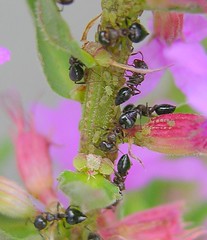 Ant Farm II
Originally uploaded by urtica.
Ant Farm II
Originally uploaded by urtica. If you are a Flickr member and would like to contribute to the Life on the Purple Loosestrife project, go here. You could win a free Flickr Pro account!
Update 8/05/05: Turns out that there is a species of aphid, Myzus lythri, that feeds only on purple loosestrife. It is thought to have been introduced from Europe around the same time purple loosestrife started showing up in the U.S. I have sent samples off to be identified and will post here when I find out what species they are.
Update 9/30/05: The ants in this photo were identified as Crematogaster cerasi by a scientist from the Systematic Entomology Laboratory. I am still waiting on the aphid id.
Monday, July 25, 2005
According to this article over at ABC News, a rust fungus (Phragmidium violaceum) used as a biological control for unwanted blackberry plants (Rubus spp.) has been accidentally introduced into the U.S. Ironically, the U.S. was considering introducing the fungus intentionally to help control the invasive Himalayan blackberry (Rubus discolor). Now the rust has been found in several spots in Oregon, first on Himalayan blackberry and later in almost every single farmed blackberry field. Oregon officials are concerned about the susceptibility the marionberry (Rubus ursinus), the state's official berry, which is also their second largest farmed blackberry crop.
Sunday, July 24, 2005
Interesting article in The Macon Telegraph about invasive species problems in Georgia. Two of the big problem plants, Chinese privet (Ligustrum sinense) and Chinese wisteria (Wisteria sinensis), are invading natural areas after decades of ornamental plantings. One homeowner notes that the wisteria in his yard might be beating out the infamous kudzu vine. This is a comprehensive article that puts the spotlight on a variety of different organism types, from plants to ants.