Sunday, December 31, 2006

Weekend Photoblogging


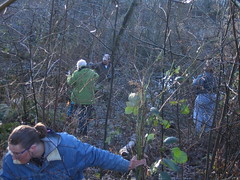
blackberry removal
Originally uploaded by EdCC HELP Club.

Volunteerism! Here the Edmonds Community College HELP Club in Washington attacks some invasive Himalayan blackberry. No worries - the volunteer in the front is wearing gloves! More photos here.

Friday, December 29, 2006

These Boots Are Made For Algae

Interesting story at stuff.co.nz about how footwear may be contributing the spread of the invasive freshwater alga known as didymo (Didymosphenia geminata, also known charmingly as "rock snot"). Apparently the felt-soled boots that have become popular among anglers are impossible to clean or disinfect in a way that assures they are algae-free. The cleaning products that anglers normally use cannot penetrate the felt properly, and the felt stays wet for a long time, allowing any embedded algae to survive.

While there is currently no legal regulation outlawing the use of felt-soled boots, freshwater anglers are being urged to switch to foam-soled ones that dry out faster and are easier to clean. As far as I can tell, the advantage of the felt soles is to prevent slipping, but IANAF so anyone who knows for sure should feel free to leave a comment.

I and the Bird...and I

The ISW has a post featured in the current "I and the Bird" carnival, hosted over at Natural Visions. While you're there checking it out, be sure to click over to the post from the Gulf Coast Bird Observatory blog about climate change and bird range expansions.

Thursday, December 28, 2006

Olive You Too!

The Chico Enterprise Record has an article, written by the Deputy Agricultural Commissioner of Butte County, California, about invasive olive trees - true olives (Olea spp.), not Russian or autumn olives (Elaeagnus spp.). The Deputy Ag Commissioner notes that abandoned olive groves in California have become vectors for crop pests, like the Olive fruit fly (Bactrocera oleae), and these pests are threatening active olive orchards. The fruits of the abandoned trees are also being dispersed by birds, and some trees have been found in wild areas.

A story featured on the ISW back in April of this year noted that the olive trees in Australia have gone feral as well.

Tuesday, December 26, 2006

History Trumps Ecology, Again

According to this report from the Palm Beach Daily News, the town of Gulf Stream, Florida is going to great lengths to maintain the historical look of a road lined with invasive trees. The Australian pines (Casuarina equisetifolia) were planted back in the 1920s as a salt-tolerant barrier to ocean spray and erosion. Unfortunately, the pines have a shallow root system, making them prone to uprooting in high winds, and not so great for erosion control after all.

Determined to keep the look of their road historically accurate, in 1996 the town had part of the road designated a "scenic vista." Now that the original plantings are dying off, the town's Landmark Preservation Commission, noting that "podocarpus is not a suitable replacement," is working to find a way around the state of Florida's ban on Australian pines. One possibility being considered: the grafting of "sterile" cultivars onto Australian pine bases.

I'm guessing the podocarpus reference is to the yew plum pine (Podocarpus macrophyllus), also a non-native species, but not considered invasive. Are any good native species to replace the pines? One potential alternative is sea grape (Coccoloba uvifera), though it may not be able to attain the proper tree stature...and of course it is completely historically inaccurate :-).

Interested readers will want to check out this ISW post about Australian pine removal in the Florida Keys, and this post about historic Paulownia trees in Philadelphia.
Monday, December 25, 2006

Shrimply The Worst

The Milwaukee Journal Sentinel is reporting that a new non-native species of shrimp, Hemimysis anomala has been discovered in the Great Lakes. The shrimp, considered native to both the Caspian Sea and the Black Sea, was found in great numbers this past November, near Muskegon port in Lake Michigan. Because that port does not see a lot of international traffic, it is thought that the shrimp were originally introduced elsewhere in the lake - biologists are expecting to find more populations closer to the point(s) of origin.

The article notes that two Canadian researchers predicted (.pdf) the arrival of this very species over eight years ago - it is the 183rd recorded in the Great Lakes, if you're keeping count :-).

Friday, December 22, 2006

Jacked Sparrow

The Western Australia Department of Agriculture and Food is reporting that a man who spotted what he thought was an odd-looking bird ended up helping prevent the establishment of an invasive species in WA. The man reported the finding to his local DAF office, and when biosecurity officers went out to the site, they were surprised to discover a tree sparrow (Passer montanus). The bird, which was captured and removed, is thought to have arrived in WA on a ship at a nearby port. Tree sparrows (.pdf) are native to Eurasia, and while discoveries of individuals in Western Australia are not infrequent, the species has not yet established any feral populations there.

Thanks to Sandy L. for sending this story in to the ALIENS-L listserver.