Residents of Colorado are being asked to keep an eye out for the Eurasian collared dove (Streptopelia decaocto) this season, according to this story in Fort Collins Coloradoan. The request has been put out by Project FeederWatch, an effort from the Cornell Lab of Ornithology to track birds at feeders across the USA. The dove, which just a few years ago was considered a rare sight, was detected at more than 20% of Colorado FeederWatch sites in 2007.
Showing posts with label citizen science. Show all posts
Showing posts with label citizen science. Show all posts
Wednesday, December 03, 2008

Wednesday, January 16, 2008
Real ID
Have you ever found a weird plant or animal in Hawaii and desperately wanted to know what it was? The Bishop Museum may be able to quench your thirst for knowledge with "Ask a Bishop Museum Scientist," a forum on the photo-sharing website Flickr. You can post photos or descriptions of insect pests or plants or animals that seem not to belong on the Hawaiian islands, and a real biologist will weigh in on the identification, along with information about whether the organisms are native or introduced and their history on the islands. While what gets posted seems to be a mix of native and non-native species, this is likely to be a valuable "Citizen Scientist" tool for spotting new potential invaders and tracking recent introductions. If you are not familiar with Flickr, a Yahoo! site that is free to join, the Bishop Museum provides instructions on how to participate here. And of course, this post would be remiss without mentioning some of the other great Flickr identification forums, all stocked with knowledgable folks: ID Please, What plant is that? and Bird Identification Help Group.
Tip of the virtual hat to KHNL8 TV for posting about this great resource.
Monday, June 25, 2007
Purple Passion
One more plug for citizen science projects from the conference at Cornell:
Got purple loosestrife (Lythrum salicaria) in your neighborhood? If so, the US government needs you to help answer important questions about the invasiblity of this plant.
Back in 2003, the USGS partnered with the Great Lakes Research and Education Center to create a citizen science project to monitor purple loosestrife in the Midwest. Last week I had the pleasure of speaking with Dr. Joy Marburger about the Purple Loosestrife Volunteers program and found her to be very passionate about it. But you don't have to be from the Midwest or even the USA to join in - they are seeking volunteers from all over the world.
Dr. Beth Middleton from the USGS National Wetlands Research Center has undertaken the job of compiling all the data, in order to assess the characteristics of purple loosestrife in both its native and introduced range. The program is looking for people who are willing to locate loosestrife populations and make a few simple observations, such as plant height, number of stems per plant, and tree canopy cover. The data could be used to determine, for example, whether the range of purple loosestrife will be altered by climate change (by taking a look at the vigor of plants along the edge of purple loosestrife's range). To learn more, check out the project homepage - contact info for Beth is at the bottom.
Saturday, June 23, 2007
Worm Hunting!
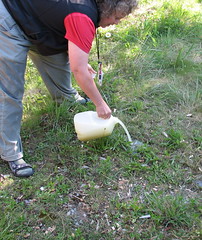
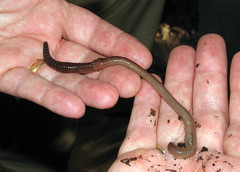
Some action shots of earthworm hunting with Cindy Hale of the Great Lakes Worm Watch.
Worm Hunting!
Originally uploaded by urtica.
Cindy Hale poured a water and mustard powder solution into the soil to scare up some worms...
Worm Hunting!
Originally uploaded by urtica.
Thursday, June 21, 2007
Worm Wishes
Posting on location from Cornell University's Citizen Science Toolkit Conference...
One of the many projects represented at the conference is the Great Lakes Worm Watch. It's a full-featured citizen science project from the University of Minnesota's Natural Resources Research Institute. Volunteers can send in samples, join existing studies, or best of all, design their own earthworm surveys.
Earthworms are not native to the Great Lakes region, but they've certainly made their presence known. Check out the Worm Watch website to find out more about the way non-native earthworms impact forest ecology, and if you're in the Great Lakes Region, consider joining in on the research!
Wednesday, June 20, 2007
Reminder: ID flora and fauna using invasive plants tonight!
Just a reminder for you to stop by the Flickr groups Life on the Purple Loosetrife and Life on the Japanese Knotweed tonight from 5-7pm EDT (21:00-23:00 GMT) for a live poster session that will be broadcast at Cornell's Citizen Science Conference. The session officially starts at 6pm but we will be setting up around 5pm. We will be posting photos and hopefully getting some serious insect and plant identification done! In fact, over the past few days over a dozen new photos have been added, several of which could use some id. More details about the project are available in the original post.
Thursday, June 14, 2007
Practice Random Sampling And Sensless Acts Of Volunteerism!
Are you an arthropod aficionado, or are you quick with the macro lens? If you're into nature and curious about how invasive plants play a part in it, consider joining the Life on the Japanese Knotweed or Life on the Purple Loosestrife project. I started those groups through the photo-sharing website Flickr as a way to collect data about the fauna and flora that use invasive plants. Now, this coming Wednesday (June 20th) from 6pm-7pm EDT, I will be presenting a live "poster" to demonstrate how these projects work, using my laptop and a wireless internet connection, at a poster session for a Citizen Science Conference at Cornell University.
Can you be around from 6-7pm EDT on June 20th to help id insects and other creatures that are posted to the group, to comment on and tag photos, or to contribute photos sometime that day? During the poster session the Flickr pages will be projected on a wall and I'll be refreshing frequently and letting the conference attendees explore the photo pages. I am even hoarding some images that I will be posting around 6pm to be sure there is proper fodder for id :-).
My goal for the live poster is twofold:
- Demonstrate that a crew of Citizen Scientists can work together to investigate valid scientific questions (in this case, What species utilize Japanese knotweed and purple loosestrife? and How does data collected by widely dispersed volunteers compare to similar studies done by rigorous local sampling?)
- Demonstrate that identification of flora and fauna can often be done simply and quickly if you get the right person to take a look (it really can, we do it on ID Please all the time!).
Feel free to cross-post this if you are inclined to spread the word. (Citizens must be getting sick of all these requests for their help doing science!)
Sunday, April 15, 2007
Weekend Shameless Self Promotion
For anyone interested in Life on the Purple Loosestrife, a citizen scientist project I started to photodocument insects and other organisms using purple loosestrife (Lythrum salicaria), I've posted a pdf version of a presentation I gave last week at the 4th Annual Massachusetts Water Resources Research Center Conference.
Since the LOTPL Project is all volunteer, all public, I felt it was only fair for any data I collect to be public as well. If you want more information, you can check out the Life on the Purple Loosestrife Flickr group, or even download the latest raw data in an Excel file.
Along with its sister project, Life on the Japanese Knotweed, this has turned out to be a very rewarding experience for me, and hopefully for some of the volunteers too :-). I am looking forward to collecting another season's worth of data this summer and hopefully recruiting some new volunteers as well!
Tuesday, September 05, 2006
Life on the Japanese Knotweed
bug of the day
Originally uploaded by urtica.
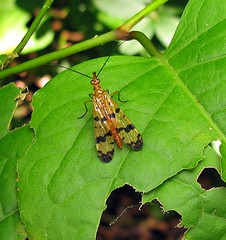
The Japanese knotweed (Fallopia japonica, Reynoutria japonica, Polygonum cuspidatum, or whatever you want to call it) is blooming around New England - what about where you live?
Flowering time is a great chance to observe some of the pollinators and other insects that use this species. If you've got knotweed, a camera, and an affinity for observing nature, consider joining Life on the Japanese Knotweed, a Citizen Science project with the goal of capturing digital records of plants and animals observed in and around the species.
Life on the Japanese Knotweed uses the photo-sharing site Flickr, and is the sister project of last year's successful Life on the Purple Loosestrife project.
Friday, April 14, 2006
The Return of Grunge?
Interesting article in the Seattle Post Intelligencer about the appearance of nutria (Myocastor coypus) in Seattle, Washington. Washington was just one of many states where the South American rodents were introduced as part of the fur trade, back in the mid-1900s. Now they have suddenly started popping up around Lake Washington and in other wetland habitats around Seattle, an no one is quite sure why.
The SPI report includes a handy sizing chart, comparing nutria to beaver and rats, and also a link to the Nutria of Union Bay project, an effort by University of Washington students to collect and analyze data using sightings from citizen scientists. Also, don't miss the link at the bottom of the page to the reader comments - some of them are a hoot!
Monday, March 22, 2004
Strangers in the Nest?
The Cornell Lab of Ornithology recently announced that their Birdhouse Network (TBN) is expanding to collect data on whether nest boxes are being used by native or non-native bird species. TBN is a volunteer citizen science project whose members enter bird-watching data via a web interface. Anyone in the U.S. can join (for a small fee).
Subscribe to:
Posts (Atom)