Thanks to esagor for sharing this photo under a Creative Commons license. Do click over to his photo page to read more about the negative impacts of non-native earthworms.
Showing posts with label earthworms. Show all posts
Showing posts with label earthworms. Show all posts
Sunday, November 25, 2007
Weekend Photoblogging
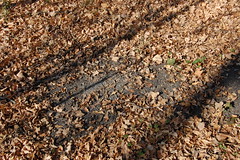
There's no "Before" shot here so you are just going to have to imagine that this patch of earth in Minnesota was once covered by a thick layer of leaf litter. You're not supposed to be able to see the exposed soil, it means that non-native earthworms have passed through and done a right job on the place.

Tuesday, November 06, 2007
Worm Woods
Holy Jumping Wormies, Batman! Sounds like Georgia has got some serious problems with Asian earthworms. Affectionately known as "Alabama jumpers" (Amynthas agrestis), these worms are known for their ability to jump right out of a bait cup. They are also known by scientists for their aggressive behavior, raising concerns that they could be having an impact on native earthworm species. Now the worms have recently been observed moving into forested areas in the Smoky Mountains, as evidenced by patches of the forest floor now completely devoid of any leaf litter. The Athens Banner-Herald has the full story, or you can read a paper on the subject here. Bonus points to the Banner-Herald for using the worm's scientific name.
Saturday, June 23, 2007
Worm Hunting!
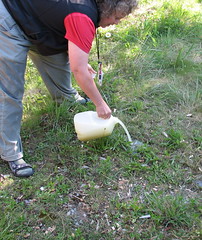
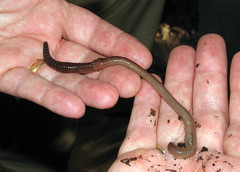
Some action shots of earthworm hunting with Cindy Hale of the Great Lakes Worm Watch.
Worm Hunting!
Originally uploaded by urtica.
Cindy Hale poured a water and mustard powder solution into the soil to scare up some worms...
Worm Hunting!
Originally uploaded by urtica.
Thursday, June 21, 2007
Worm Wishes
Posting on location from Cornell University's Citizen Science Toolkit Conference...
One of the many projects represented at the conference is the Great Lakes Worm Watch. It's a full-featured citizen science project from the University of Minnesota's Natural Resources Research Institute. Volunteers can send in samples, join existing studies, or best of all, design their own earthworm surveys.
Earthworms are not native to the Great Lakes region, but they've certainly made their presence known. Check out the Worm Watch website to find out more about the way non-native earthworms impact forest ecology, and if you're in the Great Lakes Region, consider joining in on the research!
Tuesday, February 06, 2007
Worm Front
From deep in the ISW mailbag...Mike H. sent in a link to this Boston Globe article about non-native earthworms. The topic has certainly been reported before on the ISW, but the Globe adds a nice New England flavor to it. The article notes that there could be as many as 15 different introduced earthworm species in the region, though typically no more than five of them are found in any one forest.
Saturday, April 10, 2004
The Way We Worm
Audubon Magazine has an excellent article about earthworms in their March issue. In it, the author discusses the impacts of non-native earthworms in North America, and gives tips on how to dispose of worms used as fishing bait or in compost.
Saturday, November 01, 2003
Earthworms are easy
Seems like non-native earthworms are getting a lot of attention in the American media lately. While I reported earlier this week that Asian earthworms have drawn attention to themselves in Great Smoky Mountains National Park, the Work in Progress blog noted a major New York Times article on the subject, and has been following other earthworm-related news stories.
Wednesday, October 29, 2003
Get off our duff!
Earthworms are causing problems in Great Smoky Mountains National Park, according to this report in The Daily Times. A species of earthworm, suspected to be native to Asia, cleared all the duff - the layer of decomposing plant material just below leaf litter - from a section of forest. A lack of duff can mean less nutrients in the soil, and damage to the root systems of plants in the herbaceous understory. A similar problem, but with European earthworms, was reported about a year ago in Minnesota.
Monday, November 25, 2002
The worms crawl in, the worms crawl out
A paper published in the December issue of the journal Conservation Biology concludes that European earthworms (including Eisenia hortensis) are threatening the rare goblin fern (Botrychium mormo) in forests in Minnesota. North American earthworms are found mostly in more southerly climates, so if you live in the northern parts of the continent, it's likely that all the earthworms you see are introduced. The addition of the earthworms to the forest ecosystem causes a decrease in the thickness of the forest floor. The study, done by Michael Gundale at Michigan Technological University, showed that goblin ferns were missing from parts of the forest where the litter layer was thinner. You can read about a similar study here.
Thanks to ScienceDaily for posting information about this study.
Subscribe to:
Posts (Atom)