Friday, September 08, 2006

E-grass, I've had a few...

Seems the Sierra Club is not too happy about Florida's plans to farm giant reed (Arundo donax) for use as a biofuel, according to this story from the Palm Beach Post. If the Biomass Investment Group has its way, they'll be planting 15,000 acres of the grass, burning it to generate electricity, and then selling it to a local power company.

Setting aside the fact that whoever decided to start calling this plant "e-grass" needs a stern talking-to (grrrrrr, just look at B.I.G.'s URL), consider that it may not be the best thing for Florida to purposely introduce yet another invasive species there. California, which has also entertained proposals for using giant reed as a biofuel, has been dealing with invasions in the San Diego area for over a decade.

Thanks to Lynn M. for sending in an email about this story.

Thursday, September 07, 2006

Bad Loch

The Scotsman is reporting that an invasive seaweed has been discovered in Loch Fyne, where it threatens to damage oyster and mussel fisheries. Known as Japanese wireweed (Sargassum muticum), this species is native to Japan, thought to have spread naturally from France to Scotland several years ago after it was accidentally introduced to France from Japan or British Columbia. Since its introduction, Japanese wireweed has gone on to impact Scotland's Firth of Clyde in several ways, including hull fouling, clogging of pipes, reduction of native seaweed diversity, and damaging equipment used to harvest shellfish. No effective long-term management techniques are yet available to control it.

Wednesday, September 06, 2006

We Have A Winner!

Congratulations to just john for coming up with the winning entry for the latest "Your Punny Title Here" contest. His lyrical and punny title, "Lionfish Spikes on Cape Fear? Oh, my!" will proudly be displayed at the top of that blog post for eternity*. For his creative efforts, just john will be receiving an Invasive Plant Wall Clock from the ISW store. An honorable mention goes to Martin at Salto Sobrius for "Lionizing the Atlantic."

P.S. - if anyone who entered the contest is interested in getting an aquatic invasive plant decal that comes with two free Vermont park passes, drop me an email. Seems you guys prefer the ISW store schwag and I've got park passes to spare.

(*the life of this blog)

Tuesday, September 05, 2006

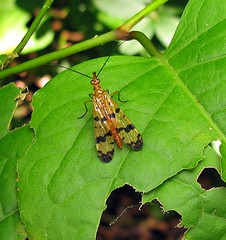
Life on the Japanese Knotweed


bug of the day
Originally uploaded by urtica.

The Japanese knotweed (Fallopia japonica, Reynoutria japonica, Polygonum cuspidatum, or whatever you want to call it) is blooming around New England - what about where you live?

Flowering time is a great chance to observe some of the pollinators and other insects that use this species. If you've got knotweed, a camera, and an affinity for observing nature, consider joining Life on the Japanese Knotweed, a Citizen Science project with the goal of capturing digital records of plants and animals observed in and around the species.

Life on the Japanese Knotweed uses the photo-sharing site Flickr, and is the sister project of last year's successful Life on the Purple Loosestrife project.

Monday, September 04, 2006

Moth Rah

ARS News is reporting that scientists may have found a better way to control the cactus moth (Cactoblastis cactorum), a South American insect that preys upon various species of prickly pear cacti (Opuntia spp.).

While there has been some success with releasing sterile male moths into wild populations (sterile insect technique, or SIT), irradiating the males to the point of sterility also left them lazy and less likely to compete with non-sterile males for a mate. Results have shown that dosing the moths with a lower level of radiation gave scientists what they needed: male moths with reduced fertility, rather than sterility, that are much more interested in finding a mate and produce sterile offspring. Field tests for this technique are currently going forward on an island in Alabama, the outermost edge of the moth invasion, which has gradually been spreading from South America up into U.S. territory.

Interested readers may also want to check out previous ISW posts about the cactus moth.

Sunday, September 03, 2006

Weekend Blog Blogging

This weekend in invasive species blogging:

Friday, September 01, 2006

Dungens and Crabbins

YubaNet is reporting that a Dungeness crab (Cancer magister), native to the west coast of the U.S., was found this past July in the Atlantic Ocean. No one is sure how the Pacific Crab got all the way across the continental U.S., but due to its size (big) and sex (male), it is suspected that it was purchased as seafood and then released. West Coast dungeness crab fisheries can only catch and sell male crabs.

This story was first reported over a month ago by MIT and also media sources such as the Underwater Times.