Tuesday, July 31, 2007

Stuffed.


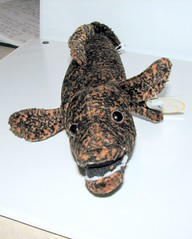
I M IN YUR POTOMAC, EETIN YUR FISHEEZ!!!
Originally uploaded by urtica

The National Audubon Society apparently gives out these cute, cuddly snakehead fish (Channa sp., I assume) as part of their advocacy efforts. I didn't manage to score one so I had to settle for a photo.

This is the most appropriate post I could think of to celebrate the fact that I've been given a Thinking Blogger award from The Voltage Gate ;-).

Monday, July 30, 2007

Ballast Blitz

I am posting this from Washington D.C., where I am participating in an effort to educate the U.S. House and Senate about ballast water management. Specifically, we are aiming to encourage the support of House Bill 2830 and Senate Bill 1578 (or whatever amalgam of those two bills is eventually created). It has been more than ten years since the first National Aquatic Invasive Species Act was passed, and that has long expired. Since then, invasive species bills have come up in various incarnations about every two years, but die before they get approved (take a trip down memory lane by searching the ISW using the legalese tag). Seems to me that it's long past time we got back on the path to invasive species prevention, and ballast water management is a good a place as any to start...just ask anyone from the Great Lakes Region).

This event is being sponsored by the National Environmental Coalition on Invasive Species, a group made up of several non-profit organizations, including the Union of Concerned Scientists and the National Wildlife Federation. I've been personally charged with visiting Congress members from my home state, Massachusetts, to plead our case. If you are concerned about ballast invaders and feeling politically motivated, especially if you are from Massachusetts, take a moment to drop an email to your Senator or Representative and let them know you heard about this issue and that you care!

Saturday, July 28, 2007

Weekend Photoblogging


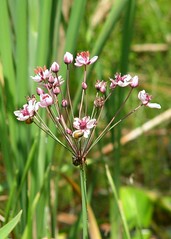
Prettiest rush ever...
Originally uploaded by urtica
This is Flowering Rush - not really a rush in the true sense, as it is its own family, the Butomaceae, rather than the Juncaceae. But if you know the form that a rush takes you can see the resemblance, minus the showy pink flowers. Butomus umbellatus is an invasive species that has been on most of the state lists here in New England since the beginning, but I had never seen it before I walked by this one, part of a large patch next to Sapsucker Woods in New York.

Friday, July 27, 2007

EBB And Stow

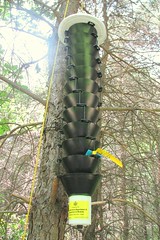
Last month while on our way back from a conference in New York, a group of us had the opportunity to stop at Schodack Island State Park. During our walk through the park we happened upon this odd contraption:


Traps + Sacrifical Tree
Originally uploaded by urtica

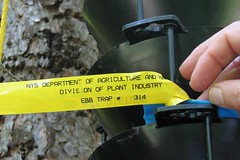
A closer inspection revealed this:

Trapping
Originally uploaded by urtica

This is what is called a Lindgren Funnel Trap, a series of plastic funnels stacked together with the intent of catching insects and sending them down to a collection container at the base. The collector was filled with a blue liquid, probably ethylene glycol (antifreeze, a preservative), and the little blue package stuck in one of the funnels likely contained some kind of attractant, maybe even alpha-pinene, according to the Exotic Wood Borer Bark Beetle National Survey Field Manual put out by APHIS (pdf).

Turns out that the New York State Department of Agriculture and Markets has been monitoring for EBBs, or "Exotic Bark Beetles" at locations all over the state for several years now. They are on the lookout for anything from the pine shoot beetle (Tomicus piniperda) to longhorn beetles to non-beetle type of insects, including the European wood-boring wasp (Sirex noctilio) recently placed on Michigan's radar. It's good to know New York and other states have an early detection protocol for insects in place, so that we'll have a better chance at fending off that "Next Big Thing"...too bad a trapping system like this won't work for plants :-).

Thursday, July 26, 2007

Closed Waters

The Naples Daily News is reporting that residents of a neighborhood in East Naples, Florida are just about fed up with their water hyacinth problem and the county's apparent lack of interest in dealing with it. The invasive water hyacinth (Eichhornia crassipes) has almost completely covered the surface of a set of private canals adjacent to a lower-income area in East Naples known as Port-au-Prince. Apparently the inaction by Collier County has to do with that word "private" - the county says they only maintain public waterways (So who the heck owns these canals and why aren't they stepping up?). Residents want the county to spray herbicide to control the aquatic weeds but the county is reluctant to do. It sounds like they will actually consider it but not on a regular basis and not unless someone finds a way to pay for it. In the meantime, residents are forced to deal with burgeoning mosquito populations and possible fish kills caused by all the stagnation that water hyacinth facilitates.

Interested readers will want to check out this article detailing a Port-au-Prince resident's efforts to convince Collier County commissioners to help out, as well as this plea from another resident. Thanks to thingfish23 of The Taming of the Band-Aid for sending in the link to the story.

Wednesday, July 25, 2007

Turns Out You Really Can Get Crabs From A Toilet Seat

UK residents impacted by the recent floods are now dealing with yet another crisis: Chinese mitten crabs (Eriocheir sinensis) crawling out of their toilets.

At first I thought this was a hoax along the lines of the infamous "toilet spider" emails that made the rounds in the late 1990s, but apparently it is real. Water levels have risen so high in the area of Hampton, England that the crabs are able to travel right up the pipes and out into people's homes. This is Local London has the story (along with a rather inappropriate photo of a mitten crab on a plate). The UK's Environment Agency is warning people to, well, keep their toilet seats down.

The crabs aren't just staying in the sewers either - The Richmond and Twickenham Times has this report about a woman who has seen dozens of them running around in her garden over the past week. Chinese mitten crabs were discovered in Europe back in the early 1900s, but until recently their populations in England had remained low. At the very least, this disaster has certainly raised their profile in the minds of homeowners across the UK.

Tuesday, July 24, 2007

Oh, Canada!

A report from the Hants Journal over at NovaNewsNow.com says that the brown longhorn spruce beetle (Tetropium fuscum) has actually been around in Canada almost a decade longer than entomologists originally thought. It turns out that specimens of the Eurasian invader were collected in 1990 but were misidentified as a native beetle in the same genus. It was not until 1999, when another infestation was discovered in Halifax, Nova Scotia, that an entomologist went back to the 1990 samples and the mistake was discovered. That means the beetle had quite an opportunity to spread unheeded. There are now over a dozen sites in Nova Scotia where the beetle can be found, leading to quarantines of wood products and threatening the local logging industry. Unfortunately, Canada doesn't seem much closer than they were in the late 1990s to developing an effective treatment to protect its forests, so for now the Forest Service is continuing with its "containment by cutting" method of management. That incensed groups like Friends of Point Pleasant Park, who were quite active a few years ago when this story originally broke - they were convinced that the government was overreacting.

Update: In the comments, Monique brings up another example of an invasive species hiding by misidentification, a parasitic plant species in Texas (Orobanche ramosa). The point here is not to belittle the identification work that biologists are doing - I know it is a gargantuan task to keep track of the various characters that define plant species, and especially insect species! It is just interesting to consider whether focusing more resources towards rigorous sampling and cataloging of flora and fauna might benefit us in the long run if it enabled us to successfully prevent invasive species from becoming established.

The other case I can think of off the top of my head is the invasive aquatic plant Hydrilla that was found in Connecticut in 1989 but misidentified as another invasive, Egeria densa. The error was not discovered until 1996. Got more examples? Post them below!

Update 2: Thanks to Chris for pointing out various inaccuracies in the article (see comments on this post). This might have been a recycled news story but it is the first time the brown longhorn spruce beetle made it onto the ISW's radar!