Friday, August 31, 2007

Tower Power

Last week I met up with some folks from Friends of the Blue Hills (FBH) to help plan a cleanup day they've scheduled at Eliot Tower. Eliot Tower is an observation tower located at the top of Great Blue Hill in the Blue Hills Reservation in southeastern Massachusetts. It's at an elevation of about 635ft and affords an excellent view of the surroundings.

Since the Reservation is state-owned property, FBH needed to coordinate their cleanup efforts with the Massachusetts Department of Conservation and Recreation. Eliot Tower is a historic building so the Friends are fairly limited in what they can do to fix things up. One of the possibilities was the removal of invasive plants, and I was asked to assess the site for possible management opportunities.

I knew beforehand that two common invaders were there: black swallowwort (Cynanchum louiseae) and Asiatic bittersweet (Celastrus orbiculatus). Upon arriving at the Tower (okay, fine, upon catching my breath following a steep climb!) I did a quick survey of the area. The wall around the building was dotted with Asiatic bittersweet, black swallowwort, and a bunch of other native and introduced plants:
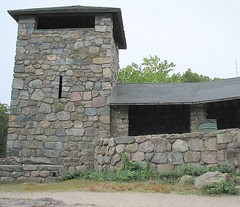
Tower and Weeds

That seemed manageable! Adjacent to the tower were a few picnic tables, and next to that was more black swallowwort:
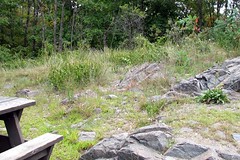
Patchy

Those patches didn't seem that bad, and there was a nice population of native blue curls (Trichostema dichotomum) right nearby - it would be good to get rid of the invader there!

The Massachusetts Natural Heritage & Endangered Species Program classifies the area around Eliot Tower as Acidic Rocky Summit. There is no real canopy there, just a lot of exposed rock and some herbs, grasses and shrubby things where the soil is found. It's dry, too, as you can probably tell from the photos - the black swallowwort is looking pretty wilty. Around the margins of the rocky open area is a mixed oak/hickory forest, with some cherry trees along the very edge:
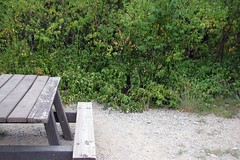
A bit of swallowwort

This still didn't look that bad, if the black swallowwort was just along the edge of the forest canopy. Then I turned to my right, and the true extent of the black swallowwort invasion began to take shape:
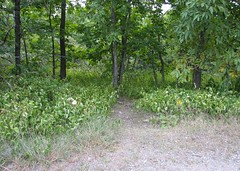
Pervasive

The vine has almost completely taken over the forest understory! It reaches back as far as the eye can see in the shot above. It also dominates the edges of the trail shown here:
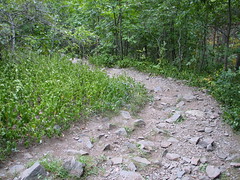
Infested trail

I am not sure when black swallowwort first arrived on Great Blue Hill, but it looks like it is there to stay, for now anyway. I feel particularly bad for these two false Solomon's seal plants (Maianthemum racemosa), holding on for dear life in a sea of swallowwort (while the swallowwort holds on to them!):
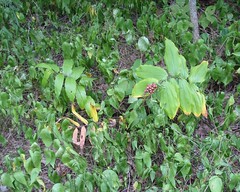
Barely holding on

It is sad to see this part of the Blue Hills Reservation lose so much of its character. Gone are most of the goldenrods, asters, and other native herbs, replaced by a monotonous view of a single, invasive species.

So what do you tell a group of volunteers eager to help clean up a site like this? A management plan to combat black swallowwort around Eliot Tower would need to go far beyond teams periodically hand-pulling the vines. For now, Friends of the Blue Hills will likely just focus their efforts on improving the physical aspects of the site (cleaning up trash and other tasks). While they could take this opportunity to do some outreach and remove the invasive plants from the perimeter of the building, but there is no practical way to prevent the black swallowwort from reinvading when it is so pervasive in the surrounding habitat. Prognosis: not good...unless you're black swallowwort.

Thursday, August 30, 2007

Crab And Go

CBC News is reporting that the European green crab (Carcinus maenas) was discovered last week off the coast of Newfoundland, Canada. This is the first record for that province and marks the most northern point for the distribution of this marine invader on the Atlantic coast of North America. The discovery was made, of course, by fishermen, who noticed multiple green crabs in Placentia Bay. Perhaps the best nugget of information from the article, for me anyway, is that fishermen refer to the green crab as "cockroach of the sea" :-). More information is available from this article at cnews.

Wednesday, August 29, 2007

Robin Hood And His Merry Moths

Sherwood Forest, one of several purported homes of Robin of Loxley (Robin Hood), is currently under threat by not one, but two different introduced moth species. According to this report at BBC News, the oak processionary moth (Thaumetopoea processionea) and the brown tail moth (Euproctis chrysorrhoea), introductions from Europe, are now both established in England. Biologists are quite concerned about the potential impact on the ancient oaks of Sherwood Forest if the moths arrive there. There is an attempt underway to manage the brown tail moth populations in nearby locations using pheremone traps...not sure what they're doing about the processionary moths though.

Thanks to biosparite for sending in a link to this story.

Tuesday, August 28, 2007

Meow Mix

The headline of this ABC News Australia story just about says it all: "Cat stew legal, may not be safe." Apparently someone in Australia submitted a recipe for cat stew in a local "bush food" cooking competition, and it's causing a bit of an uproar. The article might seem to suggest that eating cats is dangerous, but as one expert notes, it is not much different than eating any other wild animal. Is eating cat legal in your country?

Be sure to click on the audio link ("It's a nice sweet meat, not gamey like a rabbit") to get the full report. Thanks to members of the ALIENS-L listserver for posting about this story.

Monday, August 27, 2007

Like A Bull In A China Wetland?

This one is too interesting to wait for the next "New In The Literature" post...While trolling Science Direct for articles today, I came across this abstract:

"Inter-specific competition: Spartina alterniflora is replacing previous Spartina anglica in coastal China." 2007. Zhi et al. Estuarine, Coastal and Shelf Science. 74(3): 437-448.
Wow - Spartina alterniflora (smooth cord grass) really gets around, doesn't it? Native to the east coast of the U.S., this grass has traveled far and wide, invading wetlands from the west coast of the U.S. to the U.K. and all the way to the Far East. In China, where S. alterniflora arrived in the 1970s, the species is now replacing Spartina anglica, an invasive cousin whose populations have been notably dwindling since the 1990s. The study shows that S. alterniflora is outcompeting S. anglica in almost every physiological way: biomass, height, roots, leaf area...the list goes on and on. The older invader could be getting pushed right out of its niche.

Unfortunately, you're stuck with just the abstract of this article unless you or your library has a subscription to Estuarine, Coastal and Shelf Science...or you can click on the little envelope by the author's name and ask for a reprint.

Sunday, August 26, 2007

Weekend Blog Blogging

The past week in invasive species news, from other people's point of view:

Weekend Photoblogging


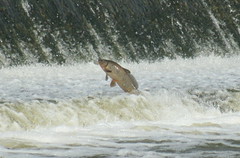
Carp 032
Originally uploaded by Jibby7
Jumping (non-native) carp in Wisconsin.

Thanks to Jibby7 for sharing this photo under a Creative Commons license!