Looks like Israel is considering making both a black list and a white list for species kept as pets. According to this article from Haaretz.com, hearings were held last month for the Israel Nature and National Parks Protection Authority to seek input from the public concerning which animal species should be allowed to be kept and sold (the white list), and which should be banned (the black list). While some of the species being considered for the black list are rare and in need of protection in the wild, the main reason for this effort is to prevent the further escape and establishment in Israel of such non-native species as the ring-necked parakeet (Psittacula krameri) and the Indian palm squirrel (Funambulus pennanti).
Friday, March 30, 2007

Thursday, March 29, 2007
Sue Do grep -l 'ballast' Michigan/*.law | xargs rm
Canada.com recently posted this report about a lawsuit brought by a group of shipping industry stakeholders from Canada, Barbados and the USA against the state of Michigan. The coalition, made up of shipping companies, shipping associations and a dock company, are claiming that the recently enacted Michigan Ballast Water Act is unconstitutional. They also say that the law places an undue burden on the industry and provides little benefit to the Great Lakes.
I did not read all of the background material from the lawsuit, but it looks like this stems from a state law that went into effect on January 1, 2007, stating that all ships entering a port in Michigan that wish to discharge ballast water must apply for a permit (and pay a fee), treat the ballast water in an approved manner, and report on such treatment. The coalition is upset that a state is trying to do the regulating, saying that it would be more appropriately done at the federal level (How long should Michigan be willing to wait for that to happen? Better yet, why not do it at an international level?).
Interested readers may want to check out this page from the Michigan Department of Environmental Quality, which provides links to several relevant documents. Also, this article from the Muskegon Chronicle names some names from the coalition.
Wednesday, March 28, 2007
Join the Blogger BioBlitz!
Jeremy over at The Voltage Gate has come up with the excellent idea that bloggers should join together during the National Wildlife Federation's Wildlife Week (April 21-29, 2007) to do some BioBlitzing. For those of you not in the know, a BioBlitz involves going out to a specific area and recording every organism you see, or can be more targeted, such as all the birds you observe over the course of a day, week, etc. It's a very simple way to record biodiversity - the power lies in the aggregation of this data among participants across time and space.
If you've got a blog and want to join in, start here. You don't need to be a science blogger to take part. Or if you're not a blogger but you're into photography, you can still participate by joining the Flickr group.
For those of you already committed, below are some logos for you to plaster all over your blogs :-). I'm releasing these under a Creative Commons Attribution-NonCommercial-ShareAlike license, so feel free to edit them however you like. In fact, here are the original xcf files (GIMP) format if you want to play with the layers: full-size logo, mini logo, participant logo. Please be nice and download the files to your own server rather than linking directly to these images!

|

|

|

|

|

|

|

|

|

|

|
|

|

|

|

(via nuthatch) |
Tuesday, March 27, 2007
Toadzilla
Ladies and gentlemen, please forgive me for interrupting your busy day, but there is an important problem I think we need to address: toad obesity. It is a sensitive subject but I think we all know who we're talking about here:

Source: BBC NewsRound
Yes that's right, several of you have sent in notes about the horror that is Toadzilla (their name, not mine), a cane toad the size of a small dog, recently discovered in Australia. Weighing in at around 2 lbs (861g), Toadzilla is the largest cane toad ever found in Australia's Northwest Territory. Thankfully, volunteers from the Kimberly Toadbusters group have already stepped in to offer their assistance as personal trainers:

Source: The West Australian
Someone needs to get these invasive beasts on the South Beach diet, stat!
(Many more ISW posts about cane toads can be found here.)
Monday, March 26, 2007
Press Keet
The "Who, What Why?" feature at BBC News has an interesting piece called "How do parakeets survive in the UK?" In it, they describe the proliferation of the ring-necked parakeet (Psittacula krameri) in British suburbia, a surprise to many that assume all brightly-colored parrots and parakeets are tropical. It turns out that ring-necked parakeets come from the foothills of the Himalayan Mountains, so they don't mind the London climate (or the Belgian one, or the German one, or the climate in the Netherlands...). The page for the story also has two opportunities for public participation: a comment section that is now full of non-native bird sightings, and a photo gallery where readers have submitted their own ring-necked parakeet photos.

Saturday, March 24, 2007
Weekend Photoblogging
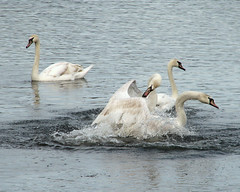
Swans of the day
Originally uploaded by urtica.
I've only ever seen mute swans (Cygnus olor) in pairs or alone, but at Farm Pond in Framingham this past Friday, there were at least 20 of them, and they were getting a little frisky :-).
On a related note, John Peter over at Invasive Notes recently blogged about a group of people very, very dedicated to their neighborhood mute swan, even after its death.
Weekend Photoblogging

Peared Up
Originally uploaded by urtica.
Bradford pears (Pyrus calleryana, also known as Callery pears) are all lined up and ready to get planted at my local Lowe's. Here in Massachusetts, it is legal to sell this species, as it is not on our state's invasive list, but it is certainly a problem plant elsewhere in the U.S.
It's nice that Lowe's is trying to be helpful to their customers by tagging their garden plants with big bright labels, but I would be happier if people made their decisions about what to plant using more than just whether the species produce FLOWERS, FRUIT or EXTRA SWEET FRUIT :-).
Subscribe to:
Posts (Atom)